
The Signs You See at Home Matter Too: When School and Home See Different Things
“They seem fine at school.”
By Mark, specialist dyslexia assessor
“They seem fine at school.”
It can be a confusing thing to hear when what you see at home feels anything but fine.
Perhaps your child reads at school but avoids reading at home.
Maybe their teacher sees completed written work, while you see the hour of support it takes to finish a piece of homework.
They might appear confident in the classroom but come home exhausted.
Or perhaps school tells you that they are making good progress, yet you continue to notice difficulties with spelling, remembering instructions or getting ideas onto paper.
So, who has the right picture?
Quite often, both of you do.
Children do not always show difficulties in the same way everywhere
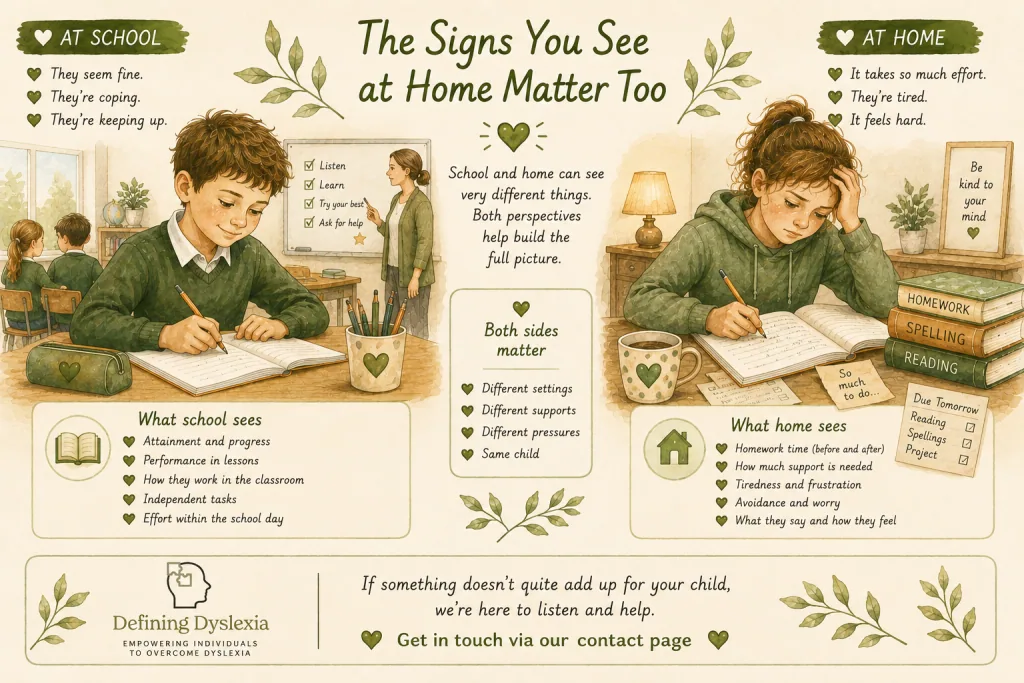
School and home are very different environments.
At school, children have routines. They may have prompts from teachers, visual information around the classroom and the structure of working alongside other children.
Tasks are also broken into lessons, and teachers can provide support that becomes such a normal part of the classroom that a child may not even recognise they are receiving it.
At home, some of those supports disappear.
That can make difficulties more visible.
There is another important difference too.
At home, you often see the before and after.
A teacher might see your child complete a reading activity.
You might see that they do not want to pick up another book that evening because they are exhausted.
School might see the finished homework.
You know that getting it finished involved repeated reminders, reassurance and considerably more time than expected.
Those observations matter.
What parents notice can be valuable information
Parents sometimes worry that what they are noticing is too subjective.
It isn't.
When we explore whether a child might have dyslexia, we do not rely on one observation or one test result. We look for patterns across different sources of information.
That includes what parents have noticed over time.
You might notice that your child regularly:
- avoids reading when they have a choice;
- becomes unusually tired after literacy-based homework;
- asks you how to spell words they have used many times before;
- needs instructions repeated;
- has good ideas but struggles to get them onto paper;
- takes much longer than expected to complete homework;
- becomes frustrated when reading aloud;
- remembers information discussed verbally but struggles with written information;
- needs considerable encouragement to begin reading or writing;
- describes themselves as “stupid” despite being capable in many other areas.
None of these observations proves that a child has dyslexia.
However, when the same things happen repeatedly, they help us build a much richer picture of how that child learns.
“But school hasn't noticed anything”
That does not necessarily mean there is nothing to notice.
Teachers have an enormously difficult job. They are observing many children at once and understandably need to use attainment and progress data as part of that process.
Some difficulties are therefore much easier to spot than others.
A child who is significantly behind with reading is likely to attract attention.
A child who reads at an expected level but does so slowly, carefully and with considerable effort may be less obvious.
Similarly, a child with strong vocabulary or reasoning skills may develop very effective ways of compensating for an area they find difficult.
This is why absence of concern at school is useful information, but it is not the only information that matters.
If your child is achieving expected results but you can see how hard they are working to achieve them, our article They’re Meeting Expectations, So Why Does Everything Feel So Hard? explores this in more detail.
And sometimes school notices things you don't see
This works both ways.
A teacher may notice things that are much harder for a parent to see.
They can compare how fluently your child reads with other children of a similar age.
They may notice how quickly your child begins a written task, how much they produce within a lesson or whether they regularly look to other pupils before following an instruction.
They can also see whether a difficulty persists despite appropriate teaching and support.
That information is extremely valuable.
This is why the most helpful conversation is rarely:
“I think there is a problem and school doesn't.”
Instead, it is:
“We seem to be seeing different things. Can we put those observations together?”
That completely changes the conversation.
Your child has a voice in this too
There is another person whose experience can sometimes be overlooked.
Your child.
Children can be remarkably insightful about the things they find difficult.
They might tell you:
“I know the word but I can't get it out.”
“I lose where I am.”
“I know what I want to write but I don't know how to start.”
“I forget what I've just read.”
“Everyone else finishes before me.”
“I can do it. It just takes me ages.”
These comments can give us information that neither school data nor parental observation can provide.
Of course, children do not always have the language to explain what is happening.
Sometimes “I hate reading” actually means “reading is really hard work.”
“I can't be bothered” can occasionally mean “I don't think I can do this successfully.”
That does not mean we should interpret every reluctance as evidence of a learning difficulty.
It means we should remain curious about what might sit underneath a repeated pattern.
You don't need to collect evidence like a detective
If you have concerns, you do not need to start documenting every spelling mistake your child makes.
You are not preparing a court case.
Instead, think about patterns.
What happens repeatedly?
When does your child struggle most?
What seems disproportionately tiring?
What can they do easily when information is presented one way but find much harder when it is presented another?
Has the same difficulty been present for a long time?
And perhaps most importantly:
What does your child say about it?
A few specific examples are usually much more useful than pages of notes.
Talk to school about what you actually see
When you speak to your child's teacher or SENCo, specific examples can help.
Rather than saying:
“My child really struggles with homework.”
You might explain:
“A piece of writing that should take about 20 minutes regularly takes us an hour, and I need to help them organise nearly every sentence.”
Instead of:
“They can't spell.”
You might say:
“They can learn their spellings for Friday, but by the following week they often cannot remember the same words.”
That gives school something concrete to explore.
You can then ask what they see in the classroom.
Does your child work independently?
How is their reading fluency?
How quickly do they complete written work?
Are they receiving prompts or support?
Is their written work consistent with what they can explain verbally?
The aim is not to persuade school that you are right.
It is to join the two pictures together.
What if I still feel something isn't adding up?
Keep asking questions.
That does not mean assuming your child has dyslexia.
There are many reasons why children can find reading, writing, memory or concentration difficult.
However, persistent concerns deserve to be understood.
Our free child dyslexia indicator check can help you think about patterns across different areas. It is not a diagnostic test, and it will not tell you definitively whether your child has dyslexia.
It can simply help you decide whether there is enough there to explore further.
If you are considering a formal assessment, our dyslexia assessments for children page explains what an assessment involves and how information from home, school and the child themselves contributes to the overall picture.
Trust your gut, then get curious
Trusting your gut does not mean assuming that your instinct must be right.
And it certainly does not mean dismissing what school is telling you.
It means recognising that what you see at home is part of your child's story too.
School sees your child learning.
You see your child before school, after school and when the school day has finished.
Your child experiences all of it.
Sometimes those three perspectives align perfectly.
Sometimes they don't.
When they don't, the answer isn't to decide which person is wrong.
It is to ask why the pictures are different.
And sometimes that question is where understanding begins.

A final word
Trusting your gut does not mean deciding that your child has dyslexia before you have all the information.
It means recognising when something does not quite add up and being willing to ask why.
School may see one part of the picture. You may see another at home, and your child has their own experience too. Bringing those perspectives together can help you understand what is really happening.
You do not need to prove that something is wrong before you are allowed to ask questions.
Trust your gut, then get curious.
About Defining Dyslexia and the author

About the author
Mark
Specialist dyslexia assessor and founder of Defining Dyslexia
Mark is a qualified teacher and specialist assessor who has worked across mainstream and SEND education, including as a SENCo. He holds an Assessment Practising Certificate and is a member of PATOSS, and he carries out every Defining Dyslexia assessment personally, from the first conversation through to talking the report through with you.
- PATOSS member
- Assessment Practising Certificate
- PGCE
- NASENCo
- CPT3A
- PgDip SpLD
About Defining Dyslexia
Diagnostic dyslexia assessments for children, adults and students
Defining Dyslexia provides full diagnostic SpLD assessments for children, adults and university and college students. Face-to-face assessments are available in Sheffield and South Yorkshire, Peterborough and Cambridgeshire, and Stamford and Rutland, with remote assessments available UK-wide. Every assessment includes time to talk through the findings together, so you leave with a clear understanding of the results rather than a document to decipher alone.
If you have questions, or you are wondering whether an assessment might be the right next step, a free 15-minute telephone call is available with no obligation.