
They’re Meeting Expectations: So Why Does Everything Feel So Hard?
Your child is meeting expectations at school.
By Mark, specialist dyslexia assessor
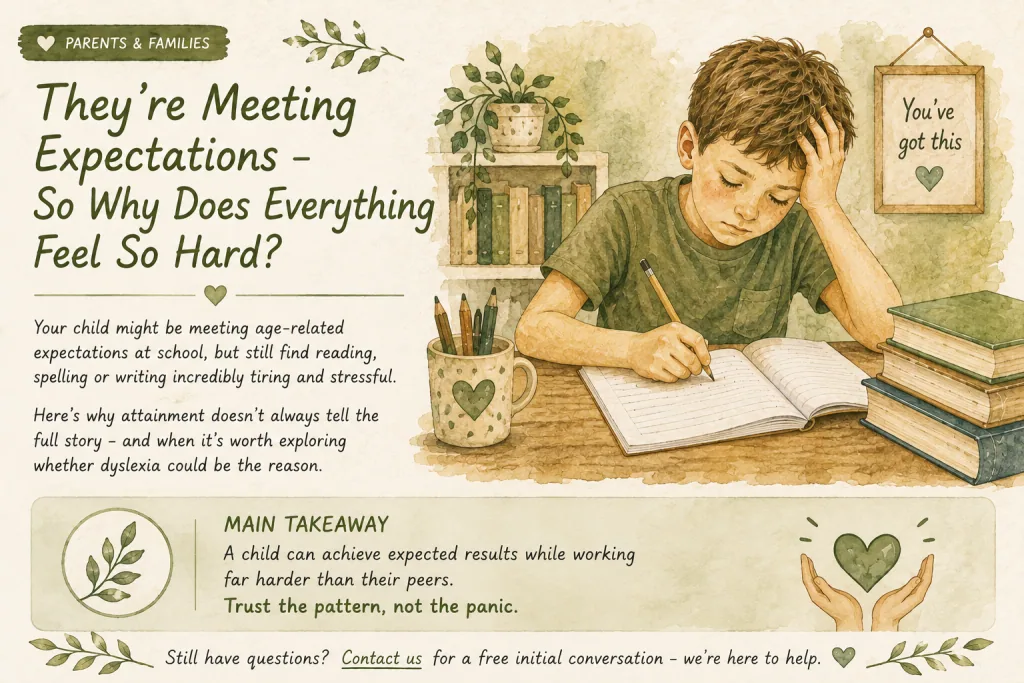
Your child is meeting expectations at school.
Their reading might be where it is supposed to be. Their teacher may tell you that they are making progress. Their school reports might look perfectly reassuring.
And yet, something still does not feel quite right.
Homework takes far longer than you think it should. Reading is tiring. Spelling words that seemed secure yesterday disappear today. They avoid writing whenever they can, or need far more help than you would expect to get started.
Perhaps they come home exhausted after holding everything together all day.
When you raise your concerns, you may hear something along the lines of:
“But they’re meeting age-related expectations.”
That can be reassuring. However, it does not always answer the question you were actually asking.
Because sometimes the important question is not simply “Can they do it?”
It is “How hard are they having to work to do it?”
Meeting expectations does not always mean learning easily
School attainment gives us useful information.
It tells us what a child can demonstrate at a particular point in time. However, it does not necessarily tell us how efficiently they reached that point.
Two children could achieve a very similar reading result while having completely different experiences of reading.
One might recognise words quickly and automatically.
The other might reach the same answer through careful decoding, rereading, using context, remembering the shape of familiar words or simply putting considerably more effort into the task.
The end result can look similar.
The journey to get there may be very different.
This is one reason dyslexia is not identified simply by looking at whether a child is above or below an expected level.
Look at the effort, not just the outcome
Parents often notice the effort before anybody notices a significant difference in attainment.
You might see that your child:
- takes much longer than expected to complete homework;
- becomes tired after relatively short periods of reading;
- avoids reading or writing when given a choice;
- needs repeated reassurance or adult support;
- knows an answer verbally but struggles to put it onto paper;
- rereads sentences several times;
- learns spellings for a test but struggles to retain them;
- becomes frustrated by tasks that appear straightforward in other subjects;
- produces much less written work than you know they are capable of discussing.
None of these things, individually, means that a child has dyslexia.
However, patterns matter.
If the same difficulties appear repeatedly, particularly over a longer period of time, they are worth exploring even when attainment remains within expected levels.
“But they can read”
This is another phrase parents often hear.
And they may well be able to read.
Dyslexia does not mean that somebody cannot read. Many dyslexic children become competent readers, particularly when they have received good teaching and support.
The difference can sometimes be seen in fluency, automaticity and effort.
A child might read a passage accurately but do so slowly. Another might read quickly but make more errors. Some children can read individual words successfully but find that concentrating so heavily on decoding leaves less capacity for understanding and remembering what they have read.
Others develop very effective strategies for compensating for areas they find difficult.
This is particularly relevant for children who have strong abilities elsewhere.
Strengths can sometimes hide difficulties
A child does not have to struggle with everything to have dyslexia.
In fact, an uneven profile can be particularly important.
A child might have excellent vocabulary and strong reasoning skills while finding phonological processing much harder.
They might understand complex ideas but struggle to express those ideas in writing.
They may have strong comprehension but read much more slowly than you would expect.
Or they might achieve perfectly respectable results while needing substantially more time and effort than their peers.
Strong abilities can help children develop ways around areas of difficulty. Sometimes those strategies are so effective that the underlying difficulty is easy to miss.
If this sounds particularly familiar, our guide to bright children who struggle with reading looks in more detail at how strengths can sometimes compensate for literacy difficulties.
Why school and home can sometimes see different things
It is also entirely possible for school and parents to have different observations without either being wrong.
A teacher sees your child within a classroom and alongside other pupils. They have valuable information about attainment, progress and how your child manages during lessons.
You see something different.
You may see how long homework actually takes.
You see the preparation needed before a task gets started. You see the frustration when nobody else is watching. You see how tired your child is after school.
You might also know that the piece of homework handed in on Friday took an hour and considerable support, even though the finished piece looks much like everybody else's.
Both pictures matter.
A good understanding of a child's learning should bring information from school, home and the child themselves together.
Average scores can still be part of a dyslexic profile
This is where things can become confusing.
Parents sometimes assume that a dyslexia assessment should produce lots of very low scores.
That is not necessarily the case.
A professional assessment looks at a pattern of strengths and difficulties across different areas. It considers literacy skills alongside areas such as phonological processing, memory and speed of processing.
It also considers the child's developmental and educational history.
A score sitting within an average range does not automatically mean there is no difficulty. Equally, one low score does not automatically mean somebody has dyslexia.
It is the overall pattern that matters.
If you would like to understand this in more detail, our guide to what dyslexia assessment scores actually mean explains how standardised scores are interpreted and why assessors look beyond individual numbers.
So should I trust my gut?
Yes, but perhaps not in the way you might think.
Trusting your gut does not mean deciding for yourself that your child has dyslexia.
It means recognising that you know your child well enough to notice when something does not quite add up.
You might not know why reading takes so much effort.
You might not know why spelling never seems to become automatic.
You might not know why a bright and articulate child produces so little on paper.
And you do not need to know.
Your job is not to diagnose the difficulty.
It is reasonable simply to say:
“I can see that my child is managing, but I can also see how hard they are having to work to manage.”
That is a perfectly valid reason to ask more questions.
What should I do if I am concerned?
Start by talking to your child's teacher or SENCo.
Rather than asking only whether your child is meeting expectations, ask more specific questions.
How fluent is their reading compared with other children of the same age?
How independently do they complete written work?
Do they need additional prompts?
Is there a difference between what they can explain verbally and what they produce on paper?
Does their teacher notice that some tasks require considerably more effort?
It can also be useful to keep brief notes about what you notice at home. You do not need to build a case or prove that something is wrong. You are simply looking for patterns.
If you are still unsure, our free child dyslexia indicator check can help you think through the areas you have noticed and whether further exploration might be useful.
What if they really are doing fine?
Then that is good news.
Exploring a concern does not commit you to an assessment, and it does not mean that you are looking for a diagnosis.
Sometimes a conversation is enough to reassure you.
Sometimes it identifies something relatively straightforward that can be supported at school.
And sometimes it confirms that there is a persistent pattern worth investigating further.
At Defining Dyslexia, we believe in being honest about that. A full diagnostic assessment is not automatically the right answer for every child.
However, neither should a child have to fall significantly behind before somebody asks why learning seems to require so much effort.
Trust the pattern, not the panic
One difficult homework session is just one difficult homework session.
A bad spelling test is just one test.
Every child gets tired, frustrated and fed up sometimes.
What matters is what happens repeatedly.
If you have been noticing the same difficulties for months or years, it is reasonable to listen to that concern.
Meeting expectations is important.
But it is not the whole story.
Sometimes a child is achieving because everything is working well.
Sometimes they are achieving because they have become incredibly good at working around something that isn't.
Understanding the difference can make all the difference.
Want to explore things without jumping straight to an assessment?
You can start with our free child dyslexia indicator check. It looks at patterns across different areas rather than giving you a simplistic yes or no answer.
If you would rather talk things through, you can also contact Defining Dyslexia for a free initial conversation. We will always give you an honest view about whether further assessment seems appropriate.
And if you are ready to understand the assessment process, our guide to dyslexia assessments for children explains what happens, what we look at and what you receive afterwards.
If you're wondering whether what you're noticing is worth acting on, it's worth reading our guides on the signs of dyslexia in children and the signs of dyslexia in adults. And if you're an adult who's already sensed it might be time, we've written more on why now is often the right moment.
A final word
Choosing when to trust your gut at first glance seem difficult, but it is personal choice. Trust that gut when you are ready!
About Defining Dyslexia and the author

About the author
Mark
Specialist dyslexia assessor and founder of Defining Dyslexia
Mark is a qualified teacher and specialist assessor who has worked across mainstream and SEND education, including as a SENCo. He holds an Assessment Practising Certificate and is a member of PATOSS, and he carries out every Defining Dyslexia assessment personally, from the first conversation through to talking the report through with you.
- PATOSS member
- Assessment Practising Certificate
- PGCE
- NASENCo
- CPT3A
- PgDip SpLD
About Defining Dyslexia
Diagnostic dyslexia assessments for children, adults and students
Defining Dyslexia provides full diagnostic SpLD assessments for children, adults and university and college students. Face-to-face assessments are available in Sheffield and South Yorkshire, Peterborough and Cambridgeshire, and Stamford and Rutland, with remote assessments available UK-wide. Every assessment includes time to talk through the findings together, so you leave with a clear understanding of the results rather than a document to decipher alone.
If you have questions, or you are wondering whether an assessment might be the right next step, a free 15-minute telephone call is available with no obligation.