What Causes Dyslexia? Genetics, the Brain and Common Myths
Dyslexia is developmental and often runs in families. Here is what is understood about genetics and the brain, what does not cause dyslexia, and how it is actually identified.
By Mark, specialist dyslexia assessor
One of the first questions people ask after a diagnosis, or while they are still wondering whether to seek one, is a simple one: why? Parents sometimes ask whether they could have done something differently. Adults often wonder whether they were simply not taught properly. Both questions are understandable, and both deserve a careful answer.
Dyslexia is developmental. It is part of how someone's language and literacy processing has developed, and it is present from early on rather than acquired later. It is not the result of a single event, a single gene or a single mistake by anyone.
Is dyslexia genetic?
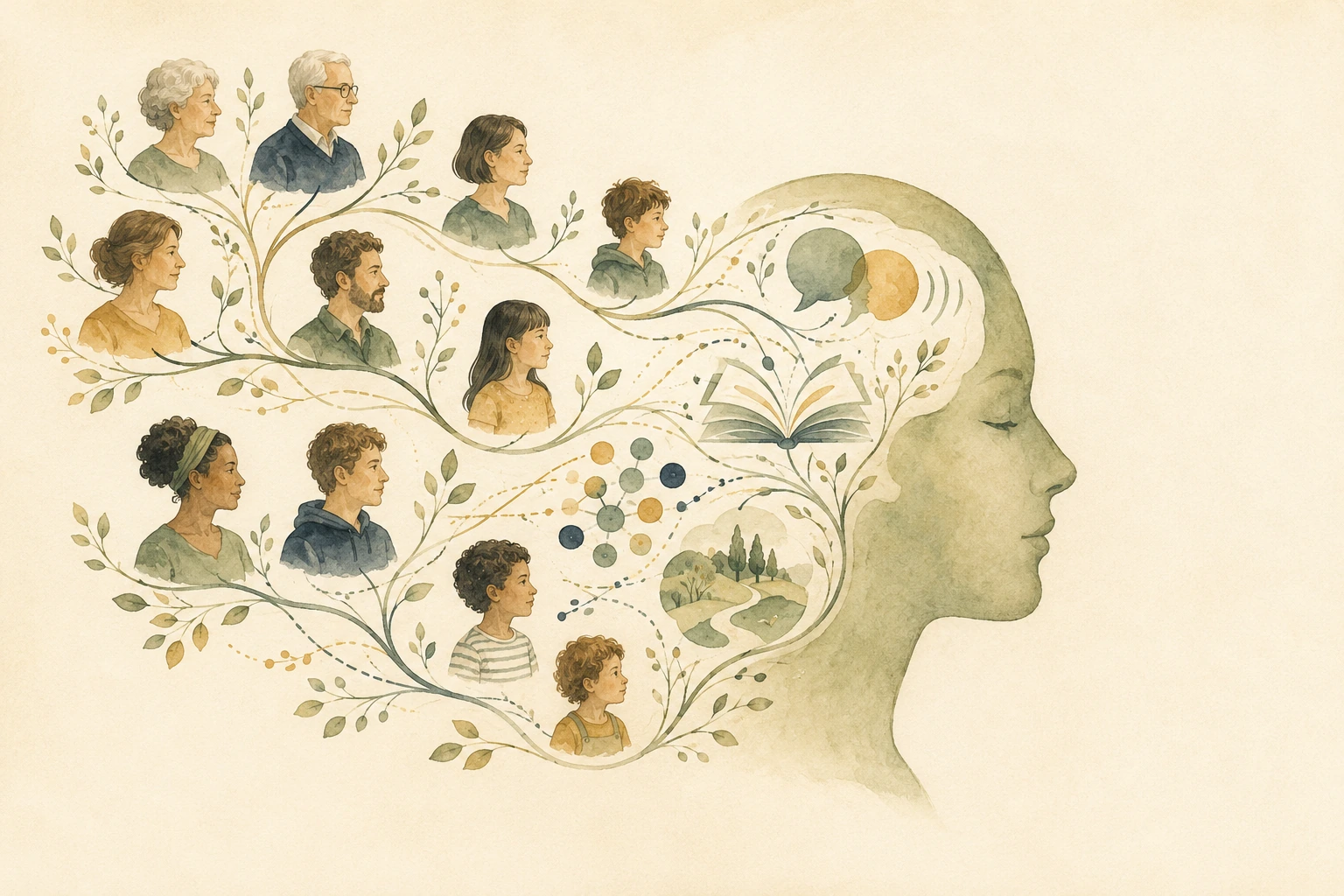
Dyslexia frequently runs in families. It is common, when taking a developmental history, to hear that a parent, grandparent, sibling, aunt or uncle also found reading, spelling or written work harder than expected, even where nobody was ever assessed.
That family pattern points to an inherited element. However, there is no single dyslexia gene. Research points to many small genetic influences interacting with one another and with a person's experiences, rather than one clear cause that can be isolated and tested for.
This also means that dyslexia is not inevitable. Some children in a family may find literacy straightforward while a sibling finds it hard work, and a family history is helpful background information rather than a prediction.
What happens in the brain?
Dyslexia involves differences in how language and written information are processed. Most commonly this affects phonological processing (hearing, holding and manipulating the sounds within words), alongside processing speed and working memory.
Those processes matter because reading and spelling are demanding tasks. A reader has to recognise letters, connect them to sounds, blend those sounds into words, hold the sentence in mind and understand the meaning, usually all at once. When one part of that chain takes more effort, the whole task takes more effort.
It is worth being clear about what this does not mean. Differences in processing are not a measure of intelligence or potential. People with dyslexia are found across the full range of ability and in every profession.
It is worth being clear about what this does not mean.
Can teaching or parenting cause dyslexia?
No. Dyslexia is not caused by parenting, by reading too little at home, by starting school late or by any lack of effort or interest from the learner.
Teaching does matter for literacy development. A child who has had disrupted schooling, or who has not yet had systematic teaching of the relationship between letters and sounds, may well be behind their peers. That is a genuine reason for poor progress and a genuine reason to act.
However, poor progress on its own does not establish dyslexia. This is precisely why an assessment looks at the pattern of strengths and difficulties alongside a person's history, rather than looking at attainment scores in isolation.
It is also worth retiring the idea that dyslexia is laziness. Most of the children and adults seen for assessment have been working considerably harder than the people around them, often for years, and are tired rather than unwilling.
Can stress, screens or eyesight cause dyslexia?
Stress, tiredness, anxiety and time pressure can all make existing difficulties much more noticeable. Reading aloud in front of a class, sitting a timed exam or writing under pressure at work can make an ordinary day feel very different. Those conditions reveal difficulties. They do not create them.
Screens do not cause dyslexia either, although screen glare, small text and poor lighting can make reading less comfortable for anyone.
Neither is dyslexia an eyesight problem, and it is not defined by seeing letters backwards. Some people do report glare, blurring, movement or losing their place while reading. That experience is real, and it may be described as visual stress, but it is a separate matter from dyslexia. We have written about this in detail in what do people with dyslexia see when they read?.
If someone has persistent blurring, headaches, double vision or text that appears to move, an eye examination with a registered optometrist is a sensible first step, whatever else is going on.
How is dyslexia identified?
A diagnostic assessment brings together two things: background information and direct assessment.
- Background and developmental history, including early language, education, previous support and what is happening now.
- Information from other people where it is useful, such as a parent, a school or a workplace.
- Standardised tasks covering reading accuracy, reading fluency, comprehension, spelling and written work.
- Underlying processes such as phonological awareness, rapid naming, working memory and processing speed.
- Strengths as well as difficulties, because the recommendations depend on both.
The purpose is to understand a pattern. A single low score means very little on its own, and a single high score does not rule anything out. What matters is whether the picture holds together and explains what the person is experiencing.
The purpose is to understand a pattern. A single low score means very little on its own, and a single high score does not rule anything out.
When might an assessment help?
Not everyone reading this needs an assessment, and plenty of people find that understanding their profile informally is enough. An assessment tends to be most useful when there is a decision to make or evidence is needed: applying for support at school or college, considering Disabled Students' Allowances, discussing adjustments at work, or simply wanting a clear explanation after years of guessing.
An assessment cannot promise a particular outcome. What it can do is give an accurate account of how someone learns, and practical recommendations based on that.
If you would like to explore the options, you can read about children's dyslexia assessments, adult dyslexia assessments or university dyslexia assessments. The free child indicator check and adult indicator check are a private way to gather your thoughts first, and a free 15-minute call is available if you would rather talk it through.
Frequently asked questions
Is dyslexia inherited?
Dyslexia often runs in families, which points to an inherited element. There is no single dyslexia gene, and a family history is useful background information rather than a prediction that a particular child will be dyslexic.
Can a brain scan or genetic test diagnose dyslexia?
No. Brain imaging and genetic research have helped build understanding of dyslexia, but they are not used to identify it in an individual. A diagnostic assessment considers background and developmental history alongside a pattern of performance across appropriate tasks.
Can poor teaching cause dyslexia?
Teaching quality affects literacy development, and disrupted or limited teaching can certainly hold progress back. However, poor progress alone does not establish dyslexia, which is why an assessment looks at the whole pattern of strengths and difficulties rather than attainment on its own.
About Defining Dyslexia and the author
About the author
Mark
Specialist dyslexia assessor and founder of Defining Dyslexia
Mark is a qualified teacher and specialist assessor who has worked across mainstream and SEND education, including as a SENCo. He holds an Assessment Practising Certificate and is a member of PATOSS, and he carries out every Defining Dyslexia assessment personally, from the first conversation through to talking the report through with you.
- PATOSS member
- Assessment Practising Certificate
- PGCE
- NASENCo
- CPT3A
- PgDip SpLD
About Defining Dyslexia
Diagnostic dyslexia assessments for children, adults and students
Defining Dyslexia provides full diagnostic SpLD assessments for children, adults and university and college students. Face-to-face assessments are available in Sheffield and South Yorkshire, Peterborough and Cambridgeshire, and Stamford and Rutland, with remote assessments available UK-wide. Every assessment includes time to talk through the findings together, so you leave with a clear understanding of the results rather than a document to decipher alone.
If you have questions, or you are wondering whether an assessment might be the right next step, a free 15-minute telephone call is available with no obligation.