Before your assessment
We build the picture together
A diagnostic assessment is not simply a series of tests. It brings together what you notice day to day, what education has observed, and what the assessment itself shows. This page explains what information helps and why, and which of it genuinely matters. Almost none of it is compulsory.
You do not need to have everything before getting in touch. Most people arrive with a worry and a few fragments, which is a perfectly normal starting point. We work with the information available and help you identify anything else that may be useful.
What information might be useful for my adult assessment?
For adults the picture is built mostly from your own account: what school was like, what is hard now, and what you have worked out for yourself along the way. That account is evidence, and it is taken seriously.
Don’t have all of this? That’s absolutely fine.
Most adults have no school records at all, and nobody is expecting you to produce any. School reports from decades ago are lovely to have and completely unnecessary. What you remember, and what you experience now, is enough to work with.
You do not need to have everything before getting in touch. We can work with the information available and help you identify anything else that may be useful.
Why background information matters
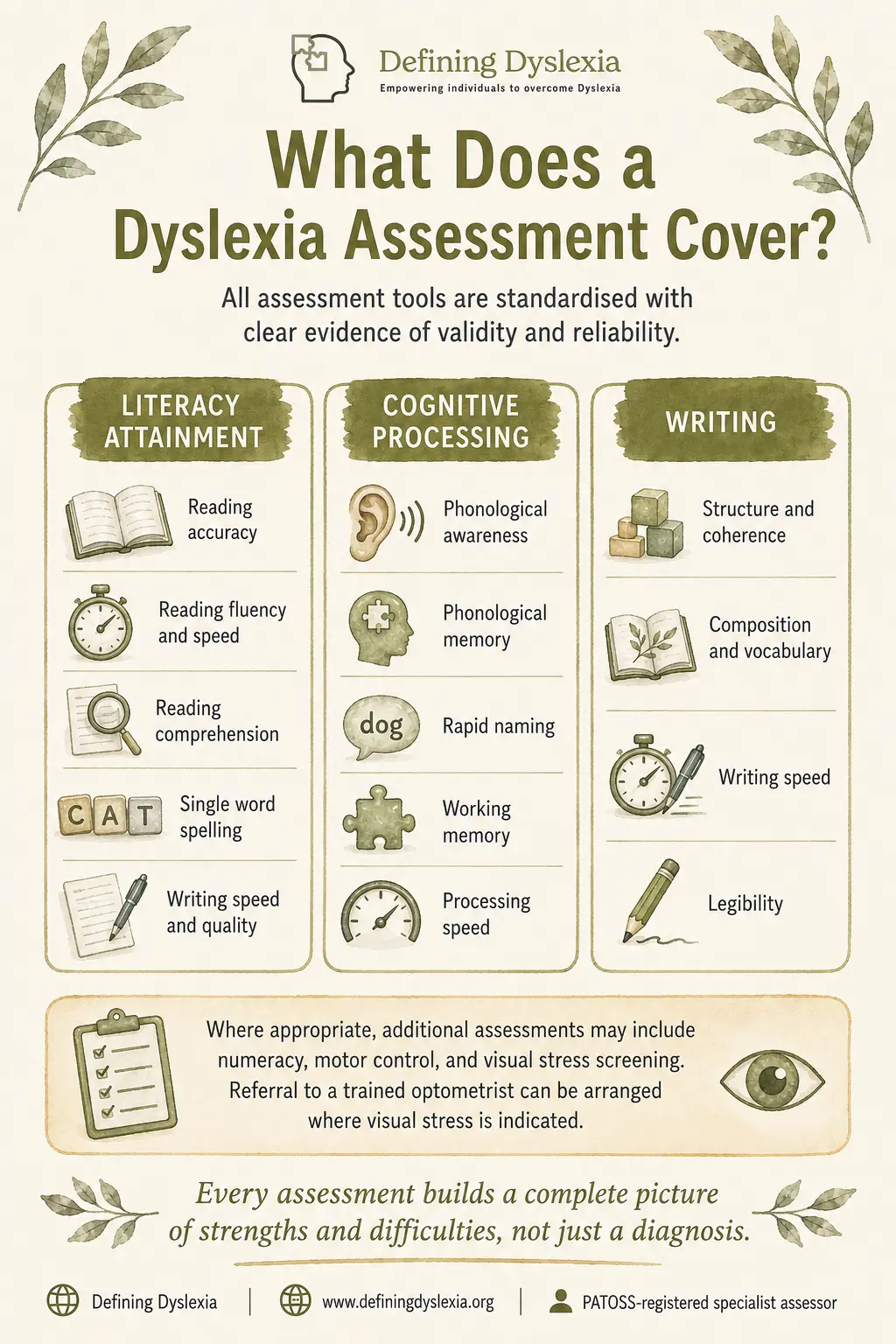
A diagnostic assessment is not a single test score. Standardised tests show how someone performs on a particular morning; background information explains what that performance means.
It shows how things developed
A snapshot on one morning cannot tell you whether a difficulty is longstanding or recent. History can.
It shows the real-world impact
Scores describe performance under test conditions. Homework, lectures and work emails describe life.
It brings strengths into view
Tests are designed to find difficulty. What someone is good at usually has to be told to us.
It puts the findings in context
The same score can mean different things depending on schooling, health, language and what has already been tried.
It makes recommendations usable
Advice that repeats what has been tried for two years helps nobody. Knowing what has happened avoids that.
What the labels mean
- Needed before the assessment
- Short list. These are the only things genuinely needed, and we will remind you.
- Really useful if you have it
- Makes the report sharper and the recommendations more practical.
- Helpful in some circumstances
- Worth a look if it is easy to find. Not worth a hunt.
- Only if it applies
- Relevant to some people and not others. Skip anything that is not your situation.
0 of 9 areas marked. Nothing here is compulsory.
- What are you good at, at work or outside it?
- What strategies have you developed without anyone teaching you?
- What technology do you rely on, dictation, text-to-speech, spellcheck, calendars, voice notes?
- What working conditions make a real difference: quiet, deadlines, notice before meetings, written follow-ups?
- Which tasks do you actively enjoy, or find easier than colleagues seem to?
- What support has genuinely helped in the past?
Not sure where to find it?
By adulthood most people have compensated for years, often invisibly and often exhaustingly. Naming those strategies matters twice over: it makes the recommendations realistic, and it makes clear that the effort was never a lack of ability.
- What prompted you to look into this, a job, a course, a child's diagnosis, years of quiet suspicion?
- What do you want the assessment to help with: workplace adjustments, study, professional exams, or simply knowing?
- If an organisation has asked you for something specific, what exactly did they ask for?
- What questions do you most want answered?
Not sure where to find it?
Knowing the purpose shapes the report. Evidence for a professional exam board, an employer and a university are not identical, and it is much easier to get this right at the start than to revisit it later.
- How learning to read went, as far as you remember it
- Spelling, handwriting and written work at school
- Whether anyone ever raised a concern, or whether it went unnoticed
- How exams felt, and whether time was ever the problem
- Any further or higher education, and how that compared
- Whether anyone in your family has literacy or learning difficulties
Not sure where to find it?
Please do not spend weeks chasing a school that may no longer hold anything. If old reports happen to be in a drawer at your parents' house, bring them. If not, your recollection is a legitimate and expected source of information. This is how adult assessment works.
- Reading: volume, speed, re-reading, reading under pressure or aloud
- Writing and spelling: emails, reports, forms, anything with an audience
- Note-taking, minutes, and listening while writing
- Memory: names, instructions, numbers, why you walked into the room
- Processing and speed: how long things take compared with colleagues
- Organisation, deadlines and juggling several things at once
- Study or professional exams, if either applies
Not sure where to find it?
Only the areas that are actually relevant to you. Nobody has all of these, and a shorter honest list is more useful than a long tentative one.
- A previous dyslexia assessment, at any age
- An online or workplace screening result
- Any educational or occupational health report
- Any other relevant professional assessment
Not sure where to find it?
An older report is still useful background even if you have been told it no longer meets the requirements of your university, employer or exam board. Those are two different questions, and it is worth bringing along.
- Workplace adjustments already agreed, and how well they work
- Any Access to Work involvement
- Arrangements for professional or academic examinations
- Extra time or other arrangements you had at school or university
- Support from a university or college, if you are studying
Not sure where to find it?
Worth saying plainly: a diagnostic report does not itself guarantee a workplace adjustment or an exam arrangement. Employers, exam boards and funding bodies each make their own decisions. What a good report does is give them accurate, specific evidence to decide with.
- Whether home, school or another agreed setting would suit best
- Whether remote assessment would actually be easier
- A quiet room, free of interruptions, for the length of the session
- Anything about timing that matters: school day, shifts, childcare, travel
Not sure where to find it?
Within the face-to-face service areas Mark travels to you. There is no assessment centre to visit. Tell us what would be easiest and we will work around it.
- An eye test within roughly the last two years, or one booked before the assessment
- Glasses or contact lenses brought and worn on the day
- Any known hearing difficulty mentioned in advance
Not sure where to find it?
A routine free NHS eye test at any high street optician is enough. It is not about ruling dyslexia in or out (vision problems and dyslexia are separate things) but reading is harder to interpret if it turns out the words were blurred. If an eye test was done recently, you have already done this.
- A short questionnaire covering education, work and current experiences
- Anything you would rather talk through than write down
Not sure where to find it?
Plenty of adults find writing about this uncomfortable, which is rather the point of the assessment. If the questionnaire is the hard part, say so and we will do it as a conversation instead.
Keep a copy
Your answers stay in this browser. There is no login, no email address and nothing to upload. Nothing on this page is sent to Defining Dyslexia. Take a copy if it helps you gather things together.
The download is a small branded file you can open, save or print on any device. “Email myself a copy” opens your own email app with the text already written, no address is collected, nothing is stored by Defining Dyslexia, and you are never added to any mailing list.
When you are ready
The next step is a conversation
A free 15-minute telephone call is usually the easiest way to work out what is worth gathering, what is not, and whether an assessment is the right step at all. There is no form to complete first, and no documents to send.
Not sure an assessment is needed yet? Try the free child indicator check or the free adult indicator check. Wondering what happens afterwards? After your assessment covers the next steps.