Before your assessment
We build the picture together
A diagnostic assessment is not simply a series of tests. It brings together what you notice day to day, what education has observed, and what the assessment itself shows. This page explains what information helps and why, and which of it genuinely matters. Almost none of it is compulsory.
You do not need to have everything before getting in touch. Most people arrive with a worry and a few fragments, which is a perfectly normal starting point. We work with the information available and help you identify anything else that may be useful.
What information might be useful for my university or college assessment?
A student assessment looks closely at the demands of your actual course. Reading volume, academic writing, note-taking in lectures and timed exams stress different things, and the report is far more useful when it knows which of those apply to you.
Don’t have all of this? That’s absolutely fine.
You do not need a school file, an old screening or a diagnosis from anyone else to start. If you have documents, bring them; if you do not, your course, your experience of it and the assessment itself are plenty to work with.
You do not need to have everything before getting in touch. We can work with the information available and help you identify anything else that may be useful.
Why background information matters
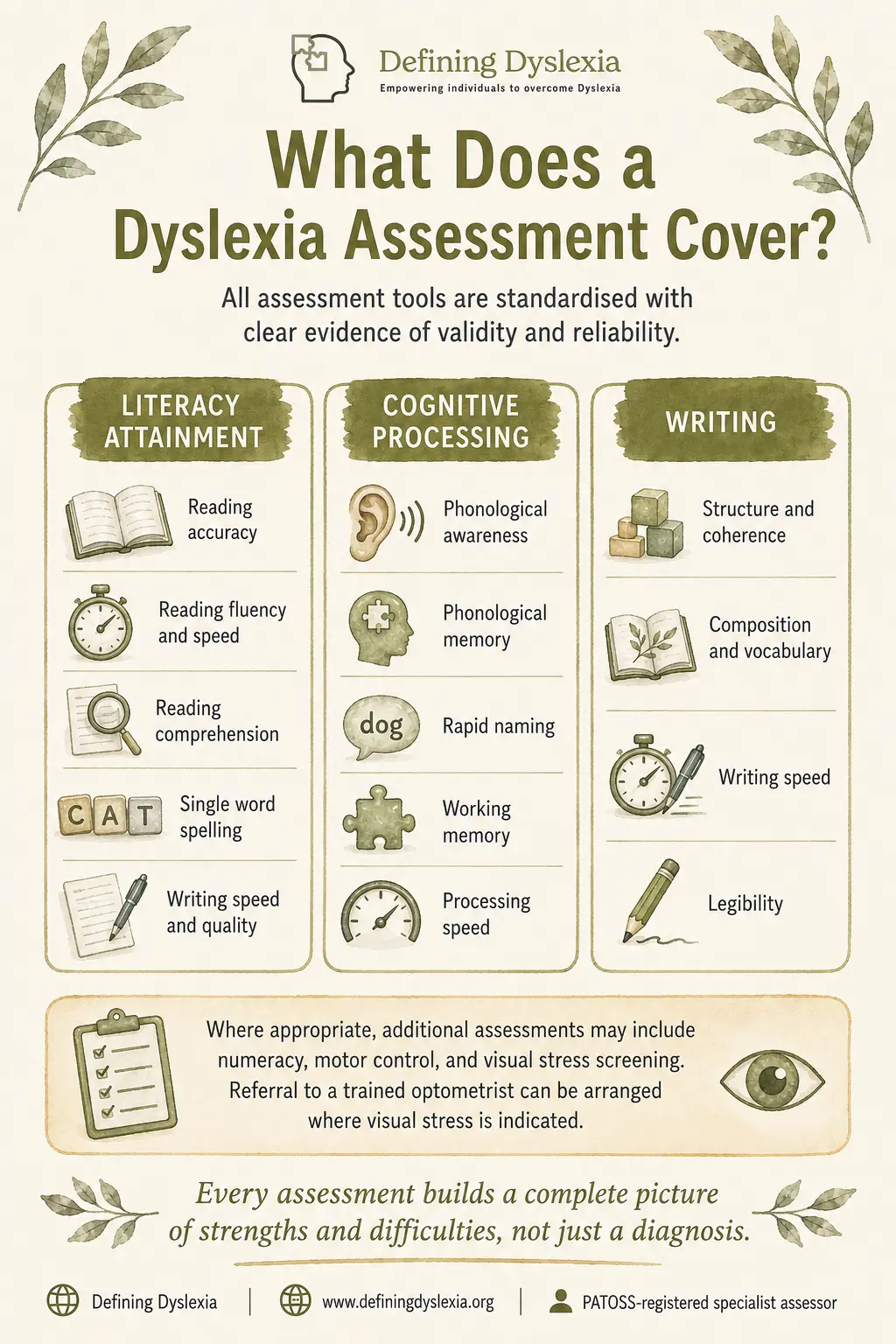
A diagnostic assessment is not a single test score. Standardised tests show how someone performs on a particular morning; background information explains what that performance means.
It shows how things developed
A snapshot on one morning cannot tell you whether a difficulty is longstanding or recent. History can.
It shows the real-world impact
Scores describe performance under test conditions. Homework, lectures and work emails describe life.
It brings strengths into view
Tests are designed to find difficulty. What someone is good at usually has to be told to us.
It puts the findings in context
The same score can mean different things depending on schooling, health, language and what has already been tried.
It makes recommendations usable
Advice that repeats what has been tried for two years helps nobody. Knowing what has happened avoids that.
What the labels mean
- Needed before the assessment
- Short list. These are the only things genuinely needed, and we will remind you.
- Really useful if you have it
- Makes the report sharper and the recommendations more practical.
- Helpful in some circumstances
- Worth a look if it is easy to find. Not worth a hunt.
- Only if it applies
- Relevant to some people and not others. Skip anything that is not your situation.
0 of 9 areas marked. Nothing here is compulsory.
- What are you good at academically, and which parts of the course suit you?
- How do you currently get reading done, audio, skimming, summaries, reading apps?
- What technology helps: dictation, text-to-speech, mind mapping, reference managers?
- How do you manage deadlines and structure when it goes well?
- Which teaching formats work best: seminars, recorded lectures, worked examples, discussion?
- What has a tutor or a friend done that genuinely helped?
Not sure where to find it?
Study strategies you invented yourself are worth recording. They show the effort behind your grades, and recommendations that build on what you already do are far more likely to be used.
- Course, institution and year of study, or the course you are about to start
- How the course is assessed: exams, coursework, presentations, placements, lab work
- Reading volume, and whether it is textbooks, papers or case law
- Any placement or professional registration requirements attached to the course
- Reading: keeping up with the list, holding on to what you read, re-reading
- Academic writing: structure, getting started, proofreading, referencing
- Note-taking in lectures, or listening and writing at the same time
- Organisation and deadlines across several modules
- Timed exams, and what happens to your writing under time pressure
- Anything that has already affected a grade or a submission
Not sure where to find it?
Recent, concrete examples are the most useful thing here: the essay that took three times as long, the exam you did not finish, the reading you have quietly stopped attempting.
- Whether literacy was ever flagged at school or college
- How GCSEs and A levels or equivalents went
- Any tutoring, literacy support or intervention along the way
- Whether anyone in your family has literacy or learning difficulties
Not sure where to find it?
Documents are a bonus, not a requirement. Many students were never picked up at school precisely because they worked hard enough to stay afloat. That pattern is itself relevant information.
- A dyslexia screening from school, college or the university itself
- A previous full diagnostic assessment, at any age
- An Educational Psychology or other professional report
- Anything your disability service has already put in writing
Not sure where to find it?
Report requirements depend on the institution, funding body and intended purpose. Older diagnostic reports may be accepted, but acceptance is not guaranteed. Check with your university or the relevant body before paying for reassessment.
- Support already provided by the university or college
- Exam access arrangements you had at school or college, and any in place now
- Whether you are applying for Disabled Students' Allowance
- What your disability or student support service has told you they need
- Any deadlines, funding bodies and exam boards work months ahead
Not sure where to find it?
Check with your disability service before booking, so the report is written to the right standard first time. To be straightforward about it: nobody can guarantee DSA eligibility or a particular adjustment in advance, those decisions sit with the funding body and your institution. A diagnostic report provides the evidence they assess.
- Whether home, school or another agreed setting would suit best
- Whether remote assessment would actually be easier
- A quiet room, free of interruptions, for the length of the session
- Anything about timing that matters: school day, shifts, childcare, travel
Not sure where to find it?
Within the face-to-face service areas Mark travels to you. There is no assessment centre to visit. Tell us what would be easiest and we will work around it.
- An eye test within roughly the last two years, or one booked before the assessment
- Glasses or contact lenses brought and worn on the day
Not sure where to find it?
A routine free NHS eye test at any high street optician is enough. It is not about ruling dyslexia in or out (vision problems and dyslexia are separate things) but reading is harder to interpret if it turns out the words were blurred. If an eye test was done recently, you have already done this.
- A short questionnaire covering education, study and current experiences
- Details of what your institution or funding body has asked for, if anything
Keep a copy
Your answers stay in this browser. There is no login, no email address and nothing to upload. Nothing on this page is sent to Defining Dyslexia. Take a copy if it helps you gather things together.
The download is a small branded file you can open, save or print on any device. “Email myself a copy” opens your own email app with the text already written, no address is collected, nothing is stored by Defining Dyslexia, and you are never added to any mailing list.
When you are ready
The next step is a conversation
A free 15-minute telephone call is usually the easiest way to work out what is worth gathering, what is not, and whether an assessment is the right step at all. There is no form to complete first, and no documents to send.
Not sure an assessment is needed yet? Try the free child indicator check or the free adult indicator check. Wondering what happens afterwards? After your assessment covers the next steps.