Understanding dyslexia
What is dyslexia?
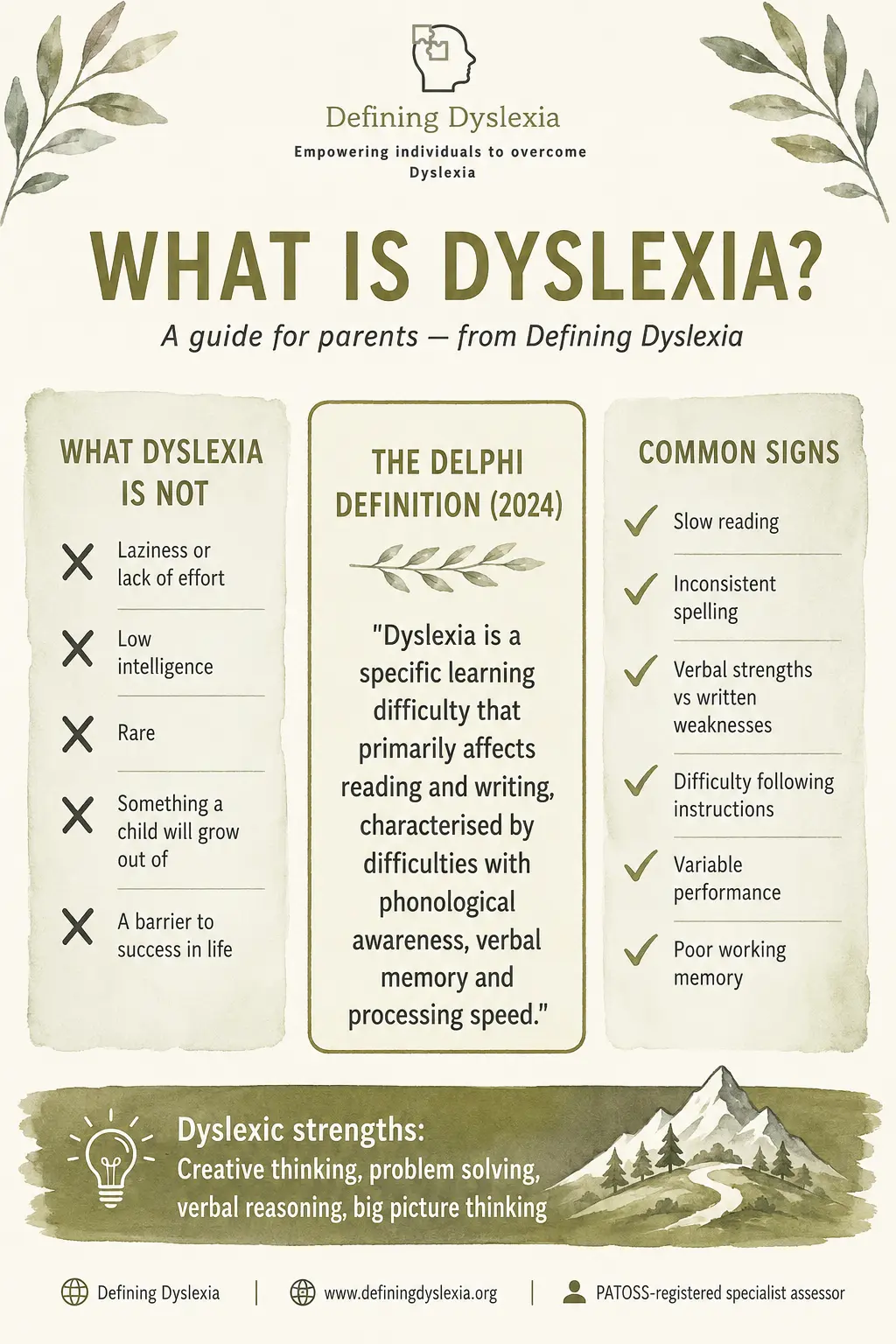
Dyslexia is a specific learning difference that mainly affects the skills involved in accurate and fluent reading and spelling. It is lifelong, it is common, and (this matters) it says nothing about how intelligent or capable someone is.
Dyslexia sits within a family of profiles known as specific learning difficulties, or SpLDs. It affects the way the brain processes written language, most often through phonological processing (the ability to hear, hold and manipulate the sounds within words) alongside processing speed and working memory.
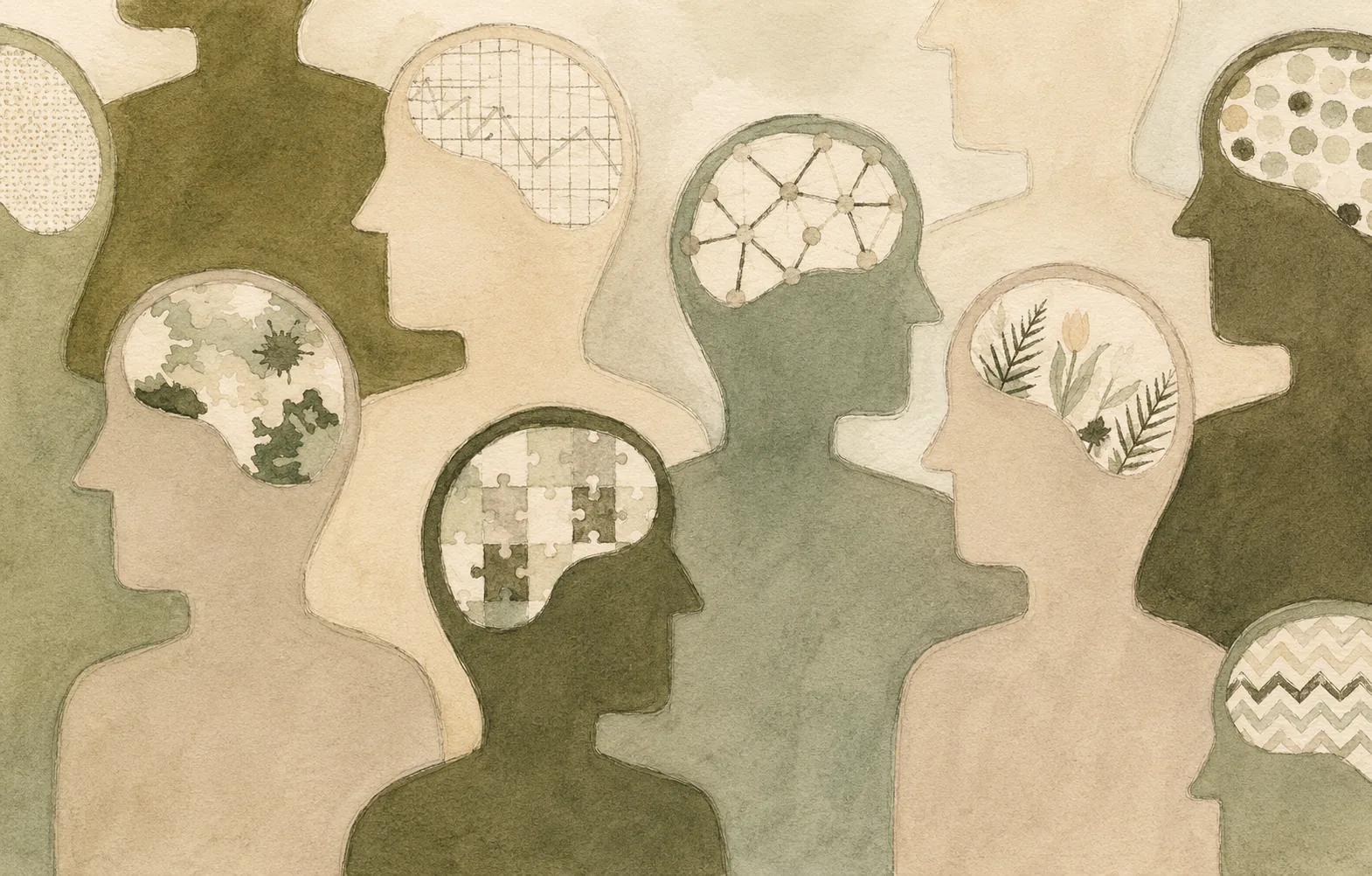
It is a difference in how information is processed, not a measure of ability, effort or intelligence. Dyslexic people are found across every level of academic and professional achievement. Many describe strengths in reasoning, problem-solving, spatial thinking, creativity and seeing the whole picture, and those strengths are part of the profile, not a consolation prize attached to it.
Because dyslexia is a profile rather than a single symptom, no two people experience it in quite the same way, and the impact changes with age, demands and support.
Two questions come up more than any others. What causes dyslexia? looks at genetics, the brain and what does not cause it, while what do people with dyslexia see when they read? explains visual stress and why it is not the same thing as dyslexia.
How it shows up
Different for different people
Dyslexia is usually described across four broad areas. Someone may find one of them significantly harder than the others, or find all four demanding to some degree.
Reading
Reading may be accurate but slow and effortful, or quick but inaccurate. Many people read perfectly well and simply find that it takes far more energy than it seems to for everyone else.
Spelling and writing
Spelling can remain inconsistent or effortful, although this is not true for everyone. Some people develop accurate spelling through strong teaching, extensive practice or compensatory strategies, while difficulties may remain in reading fluency, written expression or the speed and effort involved.
Processing speed
Written information may take longer to take in and respond to. This is why timed work (and exams in particular) can under-represent what someone actually knows.
Working memory
Holding several pieces of information in mind at once, such as a multi-step instruction or a phone number, can be genuinely hard work. It is not carelessness or inattention.
Dyslexia frequently co-occurs with other profiles, including ADHD, dyspraxia/DCD and dyscalculia. A diagnostic assessment builds a picture of the whole profile rather than testing for one label in isolation.
Download our free quick guide: A Quick Guide to Dyslexia (PDF)
Working memory is one of the processes most often affected. Download our free quick guide: A Quick Guide to Working Memory (PDF)
Some learners also find it hard to hold on to what they hear, follow verbal instructions or listen in a noisy room. Difficulties of this kind are not automatically auditory processing disorder, and we do not diagnose it or replace an audiology assessment. Download our free quick guide: A Quick Guide to Auditory Processing (PDF)
How the difficulties show up
Phonological and orthographic processing
Dyslexic profiles are not identical. Some people show clearer difficulties with phonological processing, which involves recognising and working with the sounds within words. Others may show greater difficulty with orthographic processing, which supports the recognition, storage and recall of written letter patterns and familiar words. Many people experience a combination of difficulties.
These underlying differences can affect reading, spelling and writing in different ways. They may also become less visible when someone has developed strong compensatory strategies. Difficulties exist on a continuum, and the exact presentation changes with age, teaching, support and the demands placed on someone.
Good spelling does not automatically rule out dyslexia. In the same way, one isolated spelling difficulty does not establish dyslexia. Assessment considers the wider pattern, developmental history and the amount of effort required.
A different way of explaining dyslexia
A short animated film from Made By Dyslexia
Made By Dyslexia has created a short animated film exploring what dyslexia can feel like and encouraging children and adults to recognise both their difficulties and their individual strengths.
Film and animation by Made By Dyslexia, shared from their official YouTube channel. The film loads only if you choose to play it. It presents the views and language of Made By Dyslexia and is shared to complement, not replace, the evidence-based information on this website.
Common questions
What people ask about dyslexia and SpLDs
What does SpLD mean?
SpLD stands for “specific learning difficulty” (or, increasingly, “specific learning difference”). It is the umbrella term for a group of profiles that includes dyslexia, dyscalculia, dyspraxia/DCD and dysgraphia. “Specific” is the important word: the difficulty affects particular areas rather than general ability.
Read the full guide: what is an SpLD, and how is it different to dyslexia?
Are there different types of dyslexia?
You will see labels such as phonological, surface, rapid-naming or double-deficit dyslexia. These describe patterns researchers have observed rather than separate official diagnoses, and in practice most people show a mixed profile. What matters for support is the individual pattern of strengths and difficulties, not the label attached to it.
Is dyslexia linked to intelligence?
No. Dyslexia occurs across the full range of ability, and a great many dyslexic people are able, articulate and highly capable. One of the more common reasons a child or adult goes unidentified for years is precisely that they are bright enough to compensate, often at considerable cost in effort and confidence.
Can dyslexia be mild?
Dyslexia is best understood as a continuum rather than something you either have or do not have. A profile described as “mild” can still have a significant day-to-day impact, particularly under time pressure or in a demanding academic or working environment.
What is the difference between a dyslexia screening and a diagnostic assessment?
A screening indicates whether further investigation may be worthwhile. It cannot identify dyslexia and it does not produce a diagnostic report. A full diagnostic assessment is carried out by a qualified specialist assessor, uses standardised measures across cognitive and literacy areas, and results in a formal written report.
Read the full guide: dyslexia test or dyslexia assessment: what’s the difference?
Next step
Wondering whether an assessment would help?
A full diagnostic dyslexia assessment costs £495, including the written report. Face-to-face appointments are available across South Yorkshire and the Peterborough area, and remote assessments are available UK-wide where suitable.
For a child or young person
What a child assessment involves, how to arrange one, and why the standard age is eight.
Children's dyslexia assessmentsFor an adult
Assessment as an adult, what the report gives you, and how it is used at work or in training.
Adult dyslexia assessmentsFor a student
University and college assessment, including evidence used for Disabled Students' Allowances.
University dyslexia assessmentsRead next
Going deeper in the Knowledge Centre
- What causes dyslexia? Genetics, the brain and common myths
- What do people with dyslexia see when they read?
- What is an SpLD, and how is it different to dyslexia?
- Are there different types of dyslexia?
- What is working memory, and why does it matter for dyslexia?
- Signs of dyslexia in children
- Signs of dyslexia in adults
- Dyslexia and ADHD: when they travel together