
They’re Meeting Expectations: So Why Does Everything Feel So Hard?
Your child is meeting expectations at school.
Read the articleGuidance for parents and carers
Ability and dyslexia are not mutually exclusive. A child can reason well, talk brilliantly, know a great deal and think creatively, and still find reading, spelling or written work persistently effortful. This page explains why that happens, why it is so often missed, and what is worth considering next without assuming an assessment is the answer.

The starting point
It can be genuinely confusing when a child is curious, articulate and quick to understand, yet finds reading harder than expected. Reading depends on several underlying skills becoming automatic. When one of those (phonological awareness, rapid word recognition, reading fluency) is less automatic, reading becomes slow and tiring, however capable the child is in other ways.
These strengths are real, and they matter. They are also part of the reason difficulty can stay hidden: a child who can infer meaning from context, remember what was said in class and explain ideas confidently may look secure long after reading has become a struggle.
How reading works
Unlike spoken language, reading does not develop naturally. It has to be taught, and it relies on several skills working together automatically.
Reading comprehension depends on two broad things: recognising written words efficiently, and understanding language. Strength in one can partly mask difficulty in the other, which is exactly what happens for many able children.
Listening, vocabulary, understanding language and recognising speech sounds all develop before reading. Strong spoken language is a real advantage, but it does not rule out reading difficulty.
Learning that letters represent sounds: recognising letters, blending, breaking words apart and reading unfamiliar words. At first this is slow and deliberate; with practice it usually becomes automatic.
When decoding becomes automatic, familiar words are recognised instantly and reading is smooth. If it stays effortful, most of the child's attention is spent on the words rather than the meaning.
Understanding vocabulary, making connections, drawing conclusions and remembering what was read. Some children understand a story beautifully when it is read to them, yet find independent reading exhausting.
Compensating
A child with excellent vocabulary, reasoning and spoken language may understand everything they hear. Because of those strengths they can often work out the meaning of a text even when reading it is slow and effortful. Teachers see good comprehension and reasonably assume that reading itself is secure, when in reality the child is investing far more effort than their classmates simply to recognise the words.
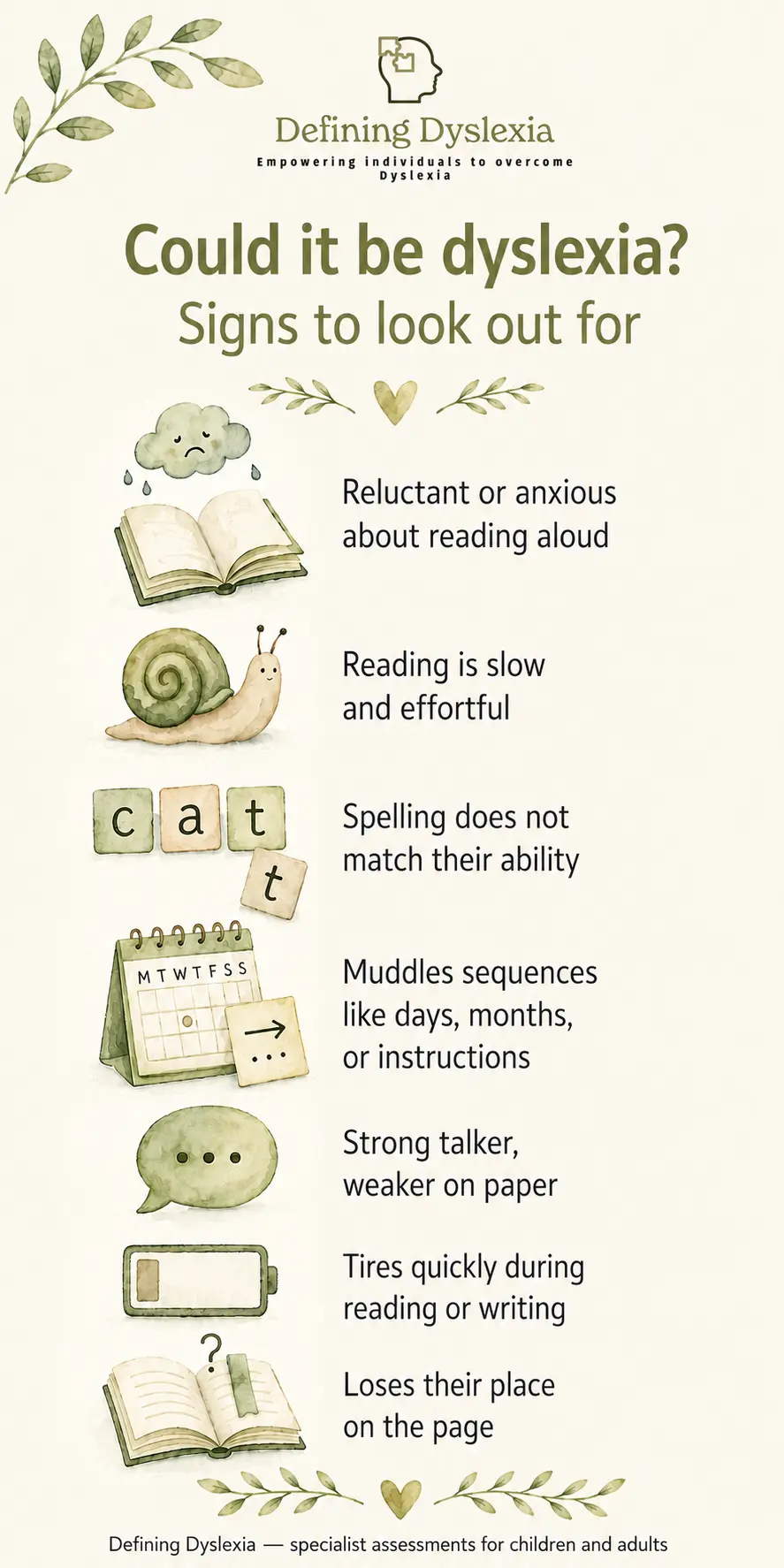
Many able children work far harder than anyone realises. They may appear to cope in class and then be mentally exhausted by home time, with homework taking much longer than expected.
Understanding a story and reading it fluently are two different skills. Excellent language comprehension can sit alongside slow, effortful word recognition.
Reading aloud is only one part of reading. Some children read accurately but slowly, with much greater effort, which affects fluency, stamina and enjoyment.
Results do not show how much effort went into them. Bright children often compensate using reasoning, memory and language, reaching expected standards while working significantly harder than classmates.
Ideas, imagination and reasoning can be strong while translating those ideas into written language is hard. Spelling, word retrieval and written expression can make work look very different from what a child actually knows.
Enjoying stories, audiobooks and talking about books in detail can exist alongside finding independent reading slow and tiring. A love of books does not rule dyslexia out.
The clue is usually effort rather than outcome. If results look acceptable but the work behind them is exhausting, disproportionate or increasingly avoided, that is worth understanding, whatever the eventual explanation turns out to be.
What you can do
Most of these cost nothing, and none of them commits you to anything.
Talk to your child's teacher or SENCo about what you see at home, especially how long tasks take and how tired your child is afterwards.
Keep a short, honest note over a few weeks: what was hard, how long it took, and how your child felt about it.
Check eyesight and hearing, which is quick to do and easy to overlook.
Try the free child dyslexia indicator check to put words to what you have noticed. It cannot diagnose anything, but it gives you a clearer profile to discuss.
If concerns persist despite good teaching and support, a full diagnostic assessment can explain why, but it is a considered step, not an automatic one.
If you do decide to assess
A full diagnostic assessment with Defining Dyslexia costs £495 and is carried out personally by Mark, a qualified specialist teacher and former SENCo holding a current Assessment Practising Certificate. It looks at literacy attainment (reading accuracy, fluency, speed and comprehension, spelling and writing) alongside cognitive processing such as phonological awareness, working memory, rapid naming and processing speed.
The value is the explanation and the recommendations, not the label. Children are assessed from age 8, and able children whose difficulties are partly hidden by compensating are a familiar part of this work. If you are unsure whether now is the right time, a free 15-minute call is usually more useful than booking anything.
Knowledge Centre
Your child is meeting expectations at school.
Read the articleDyslexia at primary school is often easy to miss. The child in question is usually bright, curious and full of ideas. Reading and writing simply do not click in the way they do for…
Read the articleIt is one of the most confusing and isolating experiences a parent can have. You know something is not quite right. You have raised your concerns with school. A screener has been carried…
Read the articleIf you've noticed that your child is struggling with reading, writing, or spelling despite working hard and receiving support, you may be wondering whether dyslexia could be a factor.…
Read the articleIt can be confusing when a child reads a passage confidently one day, yet struggles with similar words or text the next. Parents may wonder whether their child is rushing, not…
Read the articleOf all the challenges that come with dyslexia, the impact on a child's self-esteem is perhaps the one that worries parents most deeply. Watching your child conclude that they are not…
Read the articleMore in the Knowledge Centre.
The journey
Needs change as education and work change. These are the points where the demands shift most, and what Defining Dyslexia offers at each one, guidance and free resources as well as assessment.
Reading and spelling are being learned. Some able children compensate well, so difficulty can be hidden behind good comprehension and strong spoken language.
Organisation, timetables, multiple teachers and heavier reading arrive together. A little planning in Year 6 makes the move considerably calmer.
Subject vocabulary, note-taking, coursework and timed exams place different demands on literacy, memory and processing speed.
Support is requested rather than arranged for you. Knowing your own profile and who to contact matters more than it ever did at school.
Reading volume, independent study and academic writing increase. Evidence of a specific learning difficulty may be needed for study support or a DSA application.
Dyslexia looks different at work: email, reports, meetings, deadlines and reading under pressure. Many adults are identified for the first time here.
Where are you on the journey?
Different families need different things from here. Only follow the one that fits.