

Skip to content
Defining Dyslexia

Guidance for parents and carers

Preparing for secondary school with dyslexia

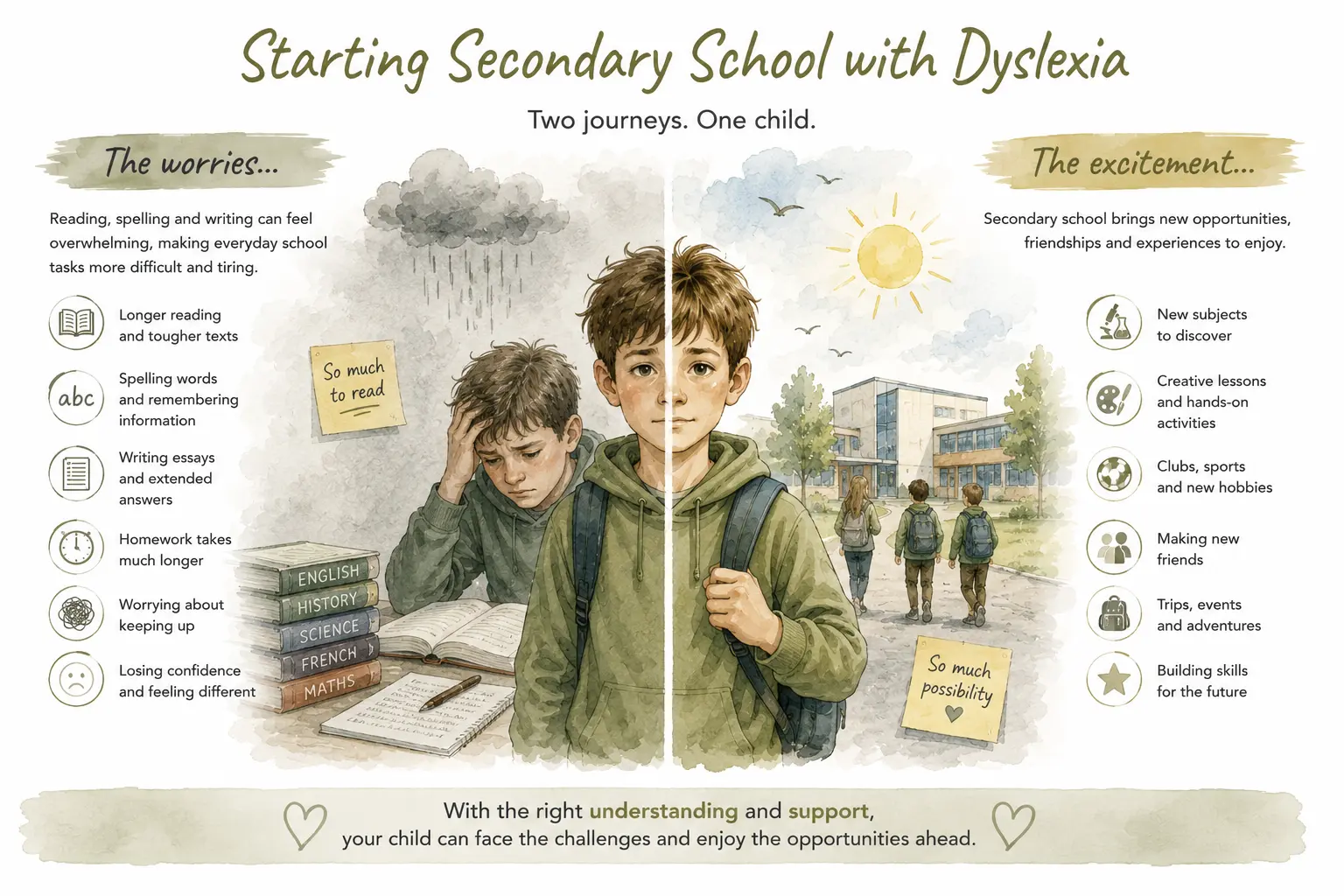
The move from primary to secondary is one of the biggest changes in a child's education, new building, new teachers, new expectations and a great deal more independence. For a dyslexic learner some of that needs a bit of planning. It does not need to be daunting: most children settle well, and a handful of practical preparations make a real difference.

Watercolour illustration of a young person with a school rucksack setting off from a garden gate on a bright morning

What changes

New demands that arrive all at once

At primary, one teacher usually knows a child extremely well. At secondary, lessons move faster, reading gets heavier, homework comes from many directions and organisation becomes the young person's own responsibility. Literacy difficulties that were previously well hidden can become much more visible, one reason some children are identified with dyslexia in Year 7 or later.

Moving between classrooms

Several rooms, several routes and a bag to keep track of. Familiarity built early takes most of the sting out of it.

Multiple teachers

Instead of one adult who knows your child well, ten or more. Shared information matters far more than it did.

Timetables

A two-week timetable, different equipment each day and no one prompting. Practising in advance genuinely helps.

Homework and deadlines

Set by different staff on different days, often recorded online. Systems, not memory, keep this manageable.

Reading and note-taking

Longer texts, subject vocabulary and writing while listening, a real change of pace for a dyslexic learner.

Independent organisation

Equipment, deadlines and asking for help all become the young person's job. This can be learned; it just needs teaching.

Free interactive resource

Preparing for Secondary School checklist

Work through this in the spring or summer term before Year 7. Tick items off as you go, print it for a meeting with school, and ignore anything that does not apply to your child.

0 of 19 ticked0%

Before the move

Most of this is a conversation rather than paperwork.

Organisation and equipment

Homework and study

Confidence and independence

Keep a copy

Your ticks are saved in this browser only. There is no sign-up and no email address needed. Take a copy with you if it helps for a meeting with school, university or work.

The download is a small branded file you can open, save or print on any device. “Email myself a copy” opens your own email app with the text already written, no address is collected, nothing is stored by Defining Dyslexia, and you are never added to any mailing list.

Printing works best from a laptop or desktop. This checklist also appears in Free resources.

Working with the school

Sharing the right information, in the right way

Secondary schools want this information. They simply receive a great deal of it in a short space of time. A one-page summary of strengths, needs and what already works is more likely to reach a subject teacher than a full report.

What is usually most useful to share

  • Strengths, interests and what your child is good at
  • The specific tasks that take longer or more effort
  • Strategies that already work, and ones that do not
  • Any assessment report, support plan or standardised scores
  • How your child prefers to ask for help

On exam access arrangements

Access arrangements are decided by the school or exam centre, in line with current regulations and the evidence they hold, including how a student normally works. A diagnostic report does not itself award extra time, a reader, a scribe, a laptop or rest breaks, and no assessor can promise those things.

What a report can do is describe the profile clearly, so the setting has good information when it makes its own decisions.

How we work with schools

Questions parents ask before Year 7

Honest answers

Should we get an assessment before secondary school?

Many parents choose to. An assessment in Year 6 means the profile and recommendations can be shared with the new school's SENCo from the start. It is a choice, not a requirement, and plenty of children move up successfully with good information and no formal assessment.

Is Year 6 a good time?

It works well. By Year 6 a child has had several years of literacy teaching, so a specialist assessor can build a clear picture. It also leaves time to discuss findings with both schools before September.

Will a diagnosis mean extra time in exams?

No. A diagnosis does not automatically result in any access arrangement. Arrangements are decided by the school or exam centre, based on current regulations, the evidence they hold and the student's normal way of working. A report can contribute useful evidence, nothing more.

What if my child is coping at the moment?

Then wait and watch. Some difficulties only become visible in Year 7 or later, when reading volume and independence increase, which is exactly why some children are identified then. Keeping notes now makes any later conversation easier.

Book a free 15-minute telephone callChoose a convenient time for a relaxed, no-obligation telephone call. Mark will call you using the number provided when booking.Child diagnostic assessment

Knowledge Centre

Reading that helps with the move

The journey

Dyslexia through life and learning

Needs change as education and work change. These are the points where the demands shift most, and what Defining Dyslexia offers at each one, guidance and free resources as well as assessment.

  1. Primary years

    Roughly ages 5–11

    Reading and spelling are being learned. Some able children compensate well, so difficulty can be hidden behind good comprehension and strong spoken language.

  2. Preparing for secondary

    Years 5–7Transition pointYou are here

    Organisation, timetables, multiple teachers and heavier reading arrive together. A little planning in Year 6 makes the move considerably calmer.

  3. Secondary and exams

    Years 7–13

    Subject vocabulary, note-taking, coursework and timed exams place different demands on literacy, memory and processing speed.

  4. Preparing for university

    Years 12–13 and mature applicantsTransition point

    Support is requested rather than arranged for you. Knowing your own profile and who to contact matters more than it ever did at school.

  5. University and college

    Higher and further education

    Reading volume, independent study and academic writing increase. Evidence of a specific learning difficulty may be needed for study support or a DSA application.

  6. World of work

    Employment and trainingTransition point

    Dyslexia looks different at work: email, reports, meetings, deadlines and reading under pressure. Many adults are identified for the first time here.