

Skip to content
Defining Dyslexia

Guidance for adults

Dyslexia at work

Dyslexia does not end with education. It simply changes shape: email instead of essays, meetings instead of lectures, deadlines instead of coursework. Many adults reach a point in their career where the effort of keeping up becomes hard to ignore, and a good number are identified for the first time then. This page is about understanding your own profile and having a practical conversation about support.

How it presents

Dyslexia looks different at work than it did at school

Nobody is marking your spelling any more, but the reading and writing demands are often heavier and the consequences feel higher. Difficulty is frequently invisible, because so much of the effort happens out of sight.

Reading complex information

Policies, contracts, technical documents and long email threads take longer to work through, particularly under time pressure.

Written communication

Emails and reports can take several drafts. The thinking is quick; getting it onto the page accurately is the slow part.

Proofreading

Errors are hard to spot in your own writing, even when you know the rules perfectly well.

Meetings and note-taking

Listening, thinking and writing at the same time is demanding. Notes may be sparse, or attention goes to writing rather than the discussion.

Processing verbal information

Multi-part instructions given quickly, or numbers and names heard once, can be hard to hold onto.

Organisation and deadlines

Juggling several pieces of work, switching tasks and tracking what is outstanding can take disproportionate effort.

The other half of the picture

Strengths and the strategies you already use

Most dyslexic adults have built an impressive set of workarounds over decades. Recognising them is not self-congratulation. It is useful evidence about what already works and what is costing you more than it should.

Strengths often reported

  • Problem-solving and seeing the whole picture
  • Practical, hands-on reasoning
  • Creativity and lateral thinking
  • Verbal explanation and persuasion
  • Spotting patterns others miss
  • Resilience built from years of working harder

Strategies adults commonly develop

  • Rereading everything twice, and starting earlier than colleagues
  • Text-to-speech, dictation and spellcheckers
  • Templates and checklists for recurring documents
  • Recording or summarising meetings afterwards
  • Asking for instructions in writing after a conversation
  • Working late or at home to catch up quietly

Support at work

Reasonable adjustments and Access to Work, briefly

Two things are worth knowing at a high level. Neither is legal advice, and both depend on individual circumstances.

Reasonable adjustments

Under the Equality Act 2010, employers may have a duty to make reasonable adjustments where a disability puts someone at a substantial disadvantage at work. What counts as reasonable depends on the role, the organisation and the individual situation, and whether the definition applies is a legal question rather than an assessment one.

In practice, adjustments are often modest and practical: software, extra time for reading-heavy tasks, written follow-ups, or a quieter place to work. For advice about your rights, speak to a suitably qualified adviser such as ACAS, a trade union or a legal professional.

Access to Work

Access to Work is a UK government scheme that can provide practical support and grants where a health condition or disability affects work. An application may lead to a workplace assessment and recommendations for equipment, software or support.

Eligibility and any award are decided by the scheme, not by Defining Dyslexia. Check the current rules on GOV.UK before making plans that depend on it.

If you would like specialist recommendations shaped around your actual job, a workplace needs assessment looks at the role itself rather than at whether dyslexia is present.

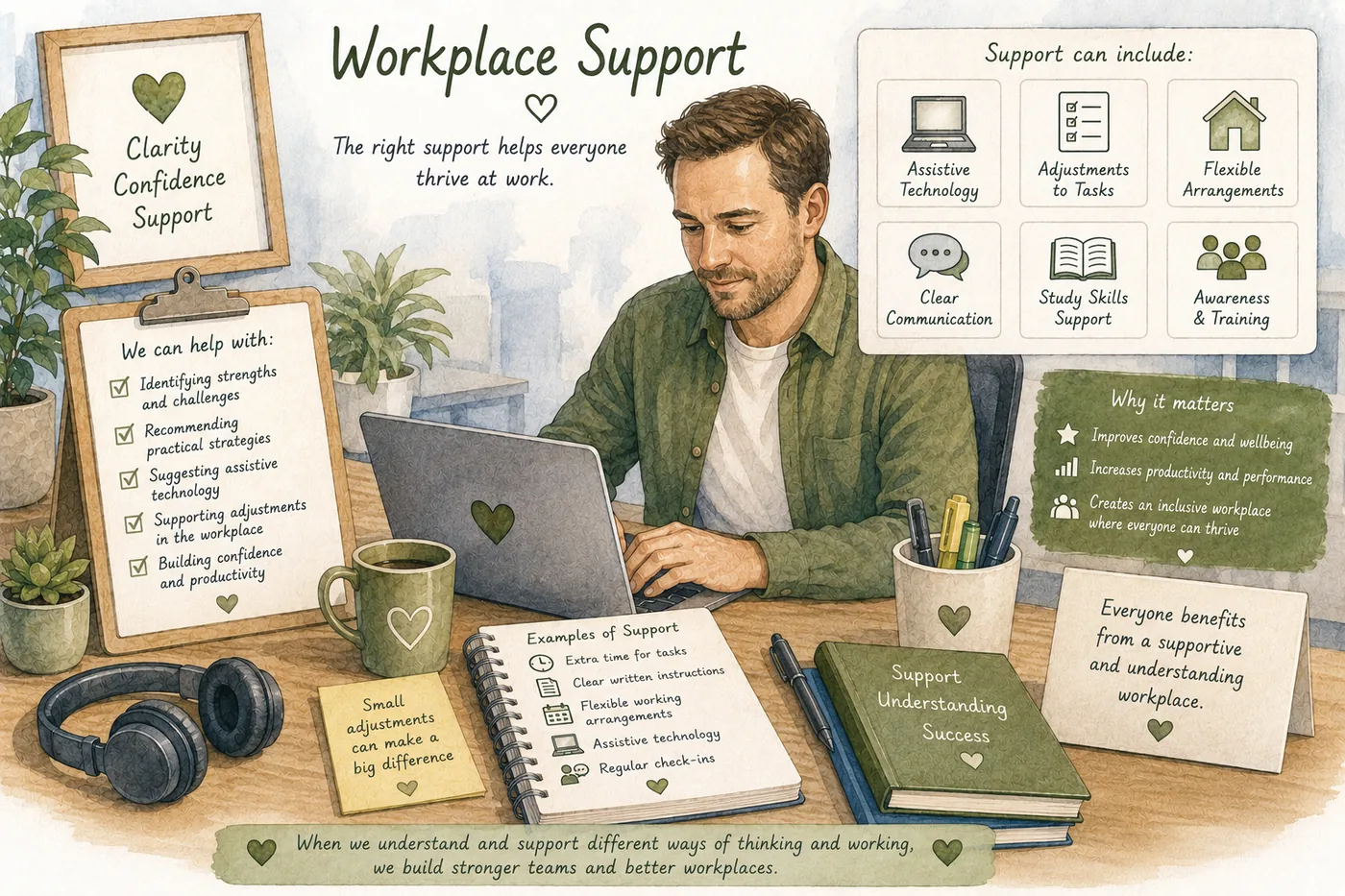
Illustrated infographic titled Workplace Support showing the kinds of help that can make a difference at work: assistive technology, adjustments to tasks, flexible arrangements, clear communication, study skills support, and awareness and training
View this illustration larger

Free interactive resource

Dyslexia at work. What helps me?

A structured way to prepare for a conversation about support at work. Work through it privately, tick what applies and print it to take with you. This is a thinking tool, not a formal workplace needs assessment, and it produces no report or recommendation.

0 of 16 ticked0%

My strengths

Start here. A support conversation goes far better when it begins with what you do well.

Tasks that take more effort

What I already do that helps

What might help

Think practically and specifically. Small changes are the easiest to agree.

Before the conversation

Keep a copy

Your ticks are saved in this browser only. There is no sign-up and no email address needed. Take a copy with you if it helps for a meeting with school, university or work.

The download is a small branded file you can open, save or print on any device. “Email myself a copy” opens your own email app with the text already written, no address is collected, nothing is stored by Defining Dyslexia, and you are never added to any mailing list.

Also listed in Free resources.

Adult diagnosis

When an assessment as an adult is worth it

An adult diagnostic assessment gives you an explanation, a clear profile of strengths and difficulties, and practical recommendations. Some people want it for workplace or study support; many simply want to understand a lifetime of finding certain things harder than everyone else seemed to.

A full diagnostic assessment costs £495, including the session and a written report. Assessments are available remotely across the UK and face to face in the Sheffield and Peterborough areas. A report is evidence that may support a conversation about adjustments. It does not oblige an employer to agree to anything, and no assessor can guarantee a particular outcome.

Adult diagnostic assessment Book a free 15-minute telephone callChoose a convenient time for a relaxed, no-obligation telephone call. Mark will call you using the number provided when booking.
Mark, specialist dyslexia assessor at Defining Dyslexia
Mark, specialist assessor, SEND consultant and former SENCo.

Your assessor

Assessed by a qualified specialist assessor

Every assessment is carried out personally by Mark, working to current SASC standards, with time afterwards to talk the report through properly.

  • Qualified teacher (PGCE, Secondary)
  • Former SENCo and Designated Safeguarding Lead
  • National Award for SEN Co-ordination (NASENCo)
  • PgDip Specific Learning Difficulties and Inclusion
  • CPT3A, psychometric testing, assessment and access arrangements
  • Current Assessment Practising Certificate (APC)
  • PATOSS member; reports written in line with current SASC guidance
Full background and qualifications

Knowledge Centre

Further reading for adults

The journey

Dyslexia through life and learning

Needs change as education and work change. These are the points where the demands shift most, and what Defining Dyslexia offers at each one, guidance and free resources as well as assessment.

  1. Primary years

    Roughly ages 5–11

    Reading and spelling are being learned. Some able children compensate well, so difficulty can be hidden behind good comprehension and strong spoken language.

  2. Preparing for secondary

    Years 5–7Transition point

    Organisation, timetables, multiple teachers and heavier reading arrive together. A little planning in Year 6 makes the move considerably calmer.

  3. Secondary and exams

    Years 7–13

    Subject vocabulary, note-taking, coursework and timed exams place different demands on literacy, memory and processing speed.

  4. Preparing for university

    Years 12–13 and mature applicantsTransition point

    Support is requested rather than arranged for you. Knowing your own profile and who to contact matters more than it ever did at school.

  5. University and college

    Higher and further education

    Reading volume, independent study and academic writing increase. Evidence of a specific learning difficulty may be needed for study support or a DSA application.

  6. World of work

    Employment and trainingTransition pointYou are here

    Dyslexia looks different at work: email, reports, meetings, deadlines and reading under pressure. Many adults are identified for the first time here.