

Skip to content
Defining Dyslexia

Post-diagnostic support

You have the report. What happens next?

An assessment is not the end of the process. The report is the starting point: a description of how someone learns, what they are good at, where the effort goes, and what tends to help. This area is about turning that into a small number of practical next steps.

The report

A report is a working document, not a verdict

It is easy to read a report looking only for whether the word dyslexia appears in the conclusion. That is the least useful way to read it. The value sits in what it describes.

Illustration of an open dyslexia assessment report showing pages of findings and recommendations
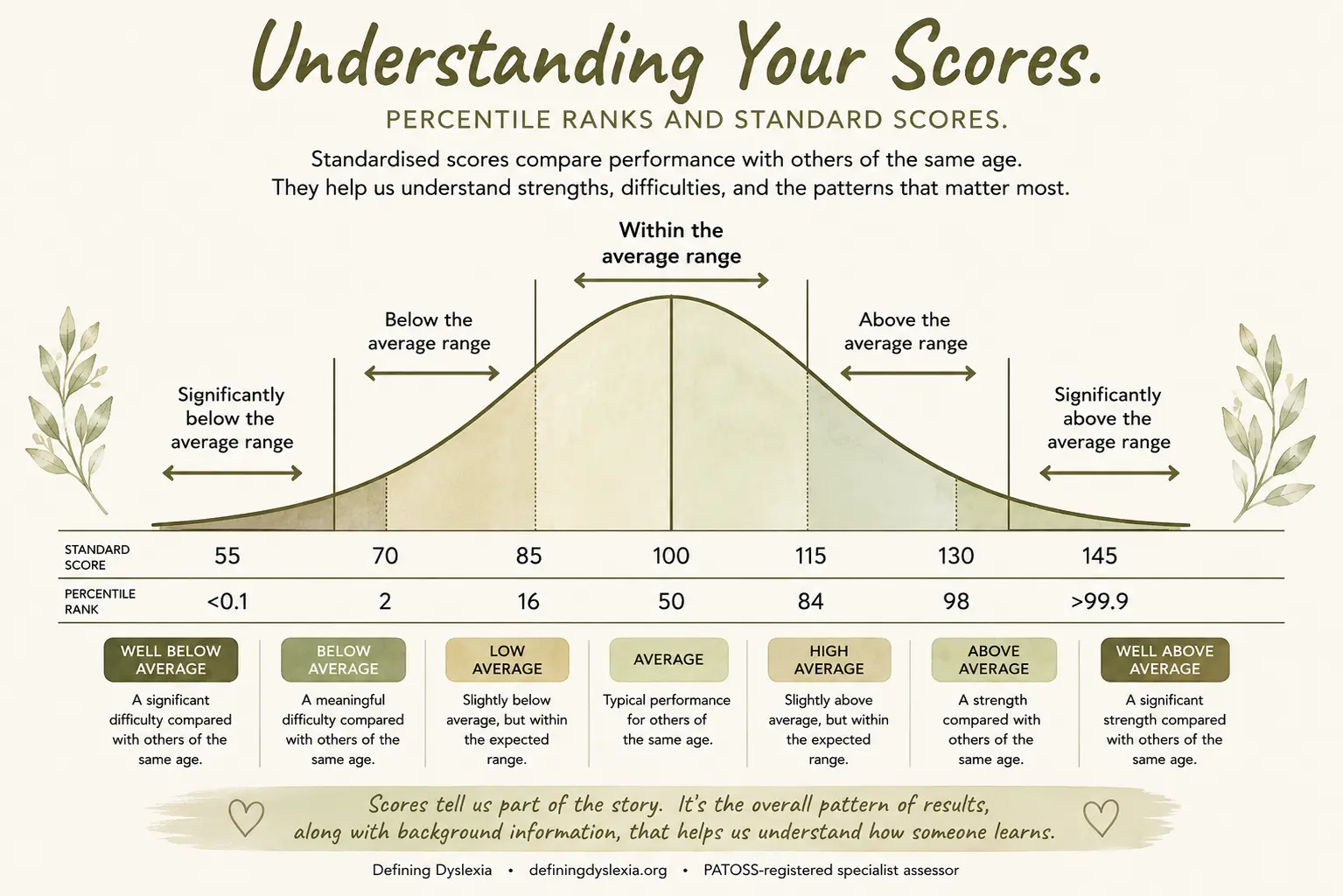
Illustration explaining how assessment scores are reported, showing standard scores, percentiles and the average range
View this illustration larger

What a good report gives you

  • Strengths, described in enough detail to be useful
  • The areas where more effort is required, and why
  • Patterns noticed during the assessment itself
  • Recommendations for teaching, study or work
  • Adjustments that may be worth considering
  • Strategies that suit this particular profile
  • Anything that may warrant further exploration elsewhere

Two pathways

Where would you like to start?

The steps after an assessment differ depending on who the report is about. Both pathways cover the same ground (understand, prioritise, share, support, review) but the practical detail is different.

Start here

Your first five steps after an assessment

Whoever the report is about, these five steps come first. Everything else can wait until these are done.

  1. 01

    Read the summary

    Start with the summary and conclusions, not the test tables. That is where the assessment says what it found and what it means.

  2. 02

    Name the strengths and the effort

    Identify two or three genuine strengths and two or three areas that take the most effort. That pairing is the profile in practical terms.

  3. 03

    Choose two or three recommendations

    A report may contain many recommendations. Nobody implements all of them at once. Pick the ones that would make the most difference this term.

  4. 04

    Share what is relevant

    Decide who genuinely needs to see the report or part of it (a SENCo, a tutor, a student support service, a manager) and have a conversation rather than only sending a file.

  5. 05

    Review after a while

    Come back to the report in a few weeks. Different sections matter at different times, and it is worth checking whether the changes you made are actually helping.

Free tool

My next steps after a dyslexia assessment

Choose who the report is about and you will get a short, practical checklist. Nothing is sent to Defining Dyslexia and no email address is needed. Your ticks are saved in this browser only.

Who is the report about?

A child or young person

Your checklist

Work through these in whatever order suits you. Print the page if you would rather have it on paper. This is general guidance, not a personalised plan.

0 of 16 ticked0%

Understand the report

You do not need to understand every score. The summary and recommendations carry most of what matters.

Talk to your child

Age-appropriate, honest and balanced, neither a disaster nor a superpower.

Share it with school

Prioritise and review

A report can contain many recommendations. Nobody implements all of them at once.

Keep a copy

Your ticks are saved in this browser only. There is no sign-up and no email address needed. Take a copy with you if it helps for a meeting with school, university or work.

The download is a small branded file you can open, save or print on any device. “Email myself a copy” opens your own email app with the text already written, no address is collected, nothing is stored by Defining Dyslexia, and you are never added to any mailing list.

This checklist is guidance only. It does not replace the recommendations in your own assessment report.

An important one

What if the assessment does not identify dyslexia?

Post-assessment support is not only for people whose report concludes dyslexia. A great deal of useful information comes out of an assessment regardless of the conclusion.

The difficulties are still real

A profile that does not meet the criteria for dyslexia does not mean nothing is hard, that the concerns were imagined, or that support is not warranted. It means that this particular explanation does not fit the pattern found.

You should not leave an assessment feeling you have simply been told what you are not.

What you still get

  • A description of strengths
  • A description of the areas that take more effort
  • A picture of how this person learns
  • Strategies and recommendations that fit that picture
  • Support that can still be discussed with a school, university or employer
  • Whether a different kind of professional input may be worth exploring

Knowledge Centre

Further reading

Written for people who have just had, or are about to have, an assessment.