Skip to content
Defining Dyslexia

Schools & professionals

Specialist assessment and SEND support for schools, colleges and professionals

Defining Dyslexia is more than a private assessment service for families. Mark is a qualified teacher and former SENCo as well as a specialist assessor, so schools can draw on diagnostic assessment, access arrangements work, SEN consultancy, SENCo cover and staff training from someone who has sat on your side of the table.

Route one

For schools & education settings

Assessment, access arrangements, consultancy, SENCo cover and training for primary and secondary schools, colleges, SENCos and SEND leaders.

Support for your setting

Route two

For professionals & referrers

Information for therapists, psychologists, tutors, SEND professionals and others who may wish to signpost, refer or work alongside Defining Dyslexia.

Partnerships and referrals

Free downloadable resources

Quick guides for schools and families

Five short, practical guides for staff and families: a free dyslexia guide for schools, ADHD classroom strategies, working memory strategies for pupils, auditory processing and listening, and attention and concentration.

Our practical quick guides explain common areas of need and provide realistic strategies that can be used at school and at home. They are designed to support early understanding, classroom discussion and conversations with a SENCo.

See all quick guides for schools and families

Free professional resource

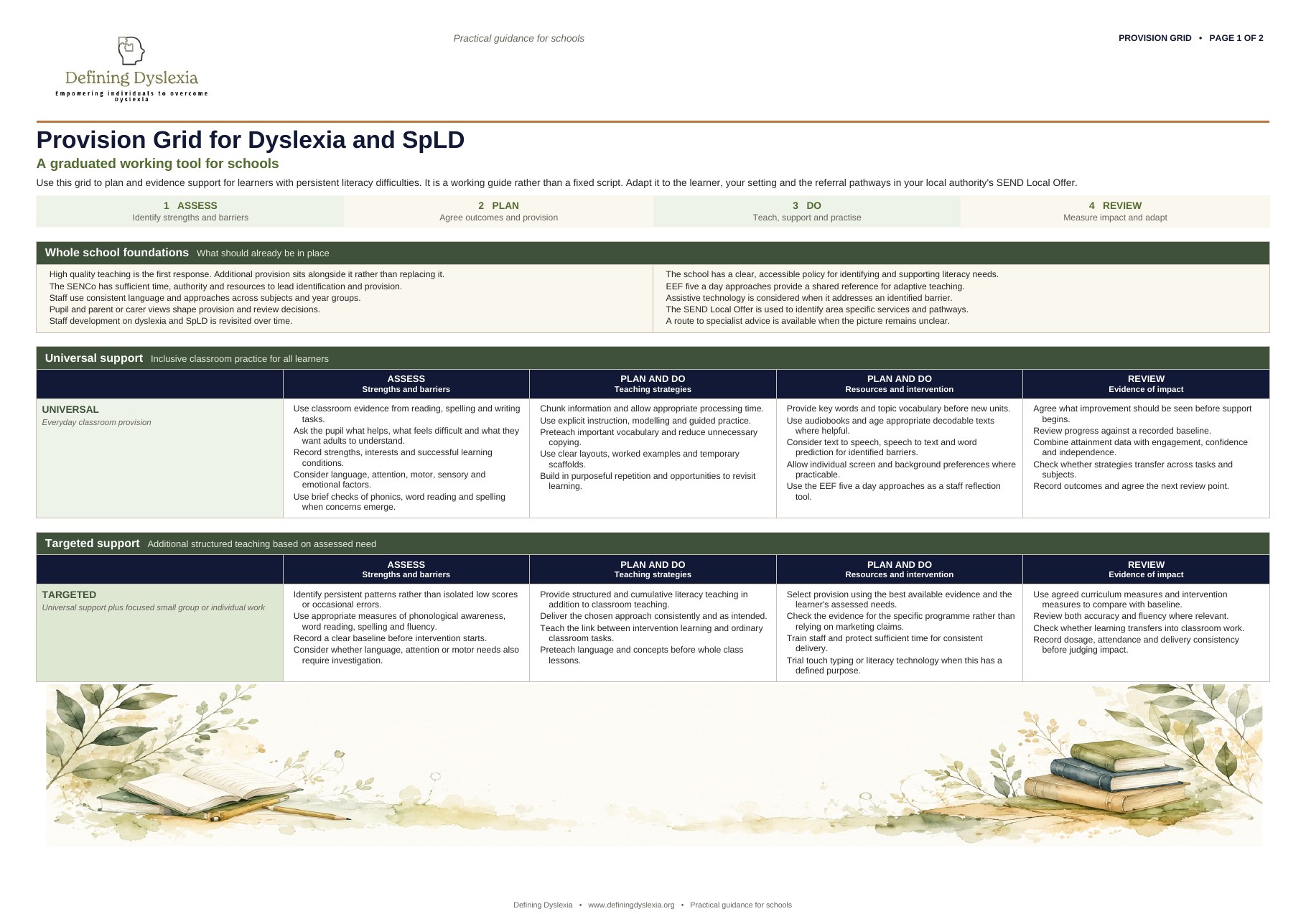
Provision Grid for Dyslexia and SpLD

A dyslexia provision grid for schools: one working document covering universal, targeted and personalised support, ready to print, share with staff and use in review meetings.

Effective dyslexia support begins with high-quality teaching and develops through a graduated response. This provision grid helps schools consider what is already in place, identify appropriate next steps and review whether support is making a meaningful difference.

Preview of the Defining Dyslexia Provision Grid for Dyslexia and SpLD

Defining Dyslexia resource · PDF · 2 pages · A3 landscape

Provision Grid for Dyslexia and SpLD

A graduated working tool for schools

A practical two-page resource to help schools assess needs, plan support, implement appropriate provision and review its impact. It covers universal, targeted and personalised support, alongside specialist assessment and trusted sources of guidance.

It sets out a graduated approach for dyslexia across universal, targeted and personalised support, with prompts for Assess, Plan, Do and Review, so that dyslexia interventions for schools can be chosen for a clear purpose and evaluated honestly.

This is a practical guidance resource. It does not replace individual assessment, professional advice or your local authority's SEND pathways.

Would your school benefit from further support?

Defining Dyslexia provides staff training, SENCo support, consultancy, diagnostic assessment and access arrangements assessment for schools and education settings.

Discuss support for your school

For schools and education settings

Ways Defining Dyslexia works with education settings

These are the services currently offered to schools and colleges. Everything is arranged directly with your setting, and it is always fine to start with a conversation about what would genuinely help.

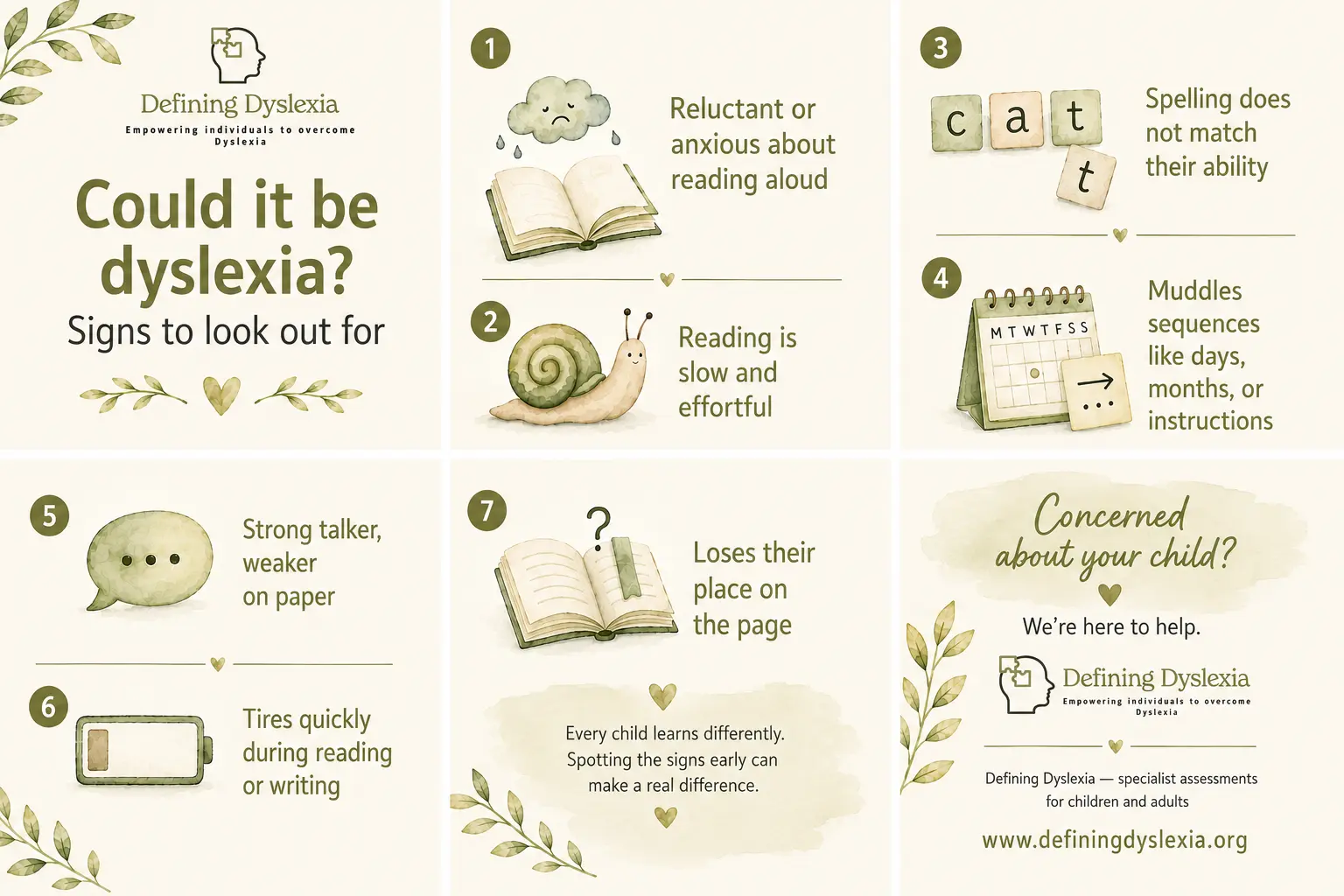
Illustration listing signs of dyslexia to look out for in a pupil, including reluctance to read aloud, slow effortful reading, spelling that does not match ability, muddled sequences, strong speech but weaker writing, tiring quickly and losing place on the page
View this illustration larger
Illustration of a specialist assessor working alongside school staff to plan support for pupils

Diagnostic dyslexia assessment

Full diagnostic assessment of a pupil or student, producing a report written in line with current SASC guidance with practical recommendations that a class teacher can actually use.

How school assessments work

Access arrangements assessment

Assessment work to support your centre's access arrangements evidence, alongside liaison with the SENCo and exams staff. The decision always remains with the centre.

Access arrangements

SEN consultancy

Guidance on inclusive policy, targeted intervention and provision for pupils with SEND, focused on practical, sustainable improvements rather than paperwork for its own sake.

SEND and SENCo support

SENCo cover

Experienced short- and medium-term SENCo cover during absence or transition, so support for pupils with SEND continues without disruption.

SENCo cover

Training and CPD

Practical SEND, dyslexia, adaptive teaching, access arrangements and autism awareness training for whole staff teams, SENCos, teaching assistants and exams officers.

Explore training

Specialist teaching

Specialist teaching support for individual learners, and advice for staff on how targeted literacy and study support can be delivered within your setting.

Specialist teaching support

Professional referrals and collaboration

Working alongside other professionals supporting your pupils, and signposting towards the right kind of service where a need sits outside dyslexia assessment.

Professional network

Advice after an assessment

Help making sense of a report, its recommendations and what they mean day to day in the classroom, including discussion with staff where families consent.

Post-assessment support

What's the challenge?

Start from the situation in front of you

Most school enquiries begin with a classroom situation, not with a service name. Find the one that sounds familiar. Each card points to the Knowledge Centre articles and free tools most relevant to it.

“A pupil is falling behind and we're not sure why”

Reading, spelling or processing concerns that don't yet have a label. Start with the indicators, then get clearer about what you are seeing.

“A parent has brought us a private report”

What the scores mean, what the report can and can't do, and how to work with the family constructively from here.

“We need access arrangements evidence”

Getting ready for formal exams. What evidence carries weight, what a diagnosis does and doesn't mean, and where the decision sits.

“The screener came back fine: but we're still worried”

Screeners are a starting point, not a verdict. What a 'no indicators' result does and doesn't rule out, and when to look further.

“Reading aloud and written work are a daily struggle”

The classroom-level reality. Why reading aloud is so hard, what actually helps, and how it looks from the pupil's chair.

“We're not sure whether to assess, train or adapt”

The decision-level question. Use the free tools to narrow down what this situation actually needs before committing to anything.

Want the reading list, not just the routes in?

The SENCo & teacher resources library curates the most useful Knowledge Centre articles and free tools for common classroom, transition, exam and family scenarios, organised for staffroom and CPD use.

Open the SENCo & teacher resources library

Free reflection tools

Free, printable tools for SENCos and teachers

No sign-up, no email address, no cost. Each of these is a reflection tool, a structured way to gather and organise what you are seeing, not a screening result and never a diagnosis. Print them, save them as PDF, and share them with families as freely as you like.

  • FreePrint or save as PDF

    Child dyslexia indicator

    A structured questionnaire covering the signs that matter at school and at home. An indicator for reflection only. It does not diagnose.

    For staff: Use it to structure classroom observations before a parents' meeting or a referral conversation.

  • FreePrint or save as PDF

    Adult dyslexia indicator

    The same idea for older students and adults, work history, study patterns and the signs that persist beyond school. Reflection only, not a diagnosis.

    For staff: Relevant for sixth form and FE students, and for staff wondering about themselves.

  • FreePrint or save as PDF

    “What evidence helps” checklist

    Three groups of evidence that carry weight for access arrangements, with a reminder that the centre decides and nothing is automatic.

    For staff: Work through it with the exams officer before the access arrangements window opens.

  • FreePrint or save as PDF

    Secondary transition checklist

    A printable checklist for the primary-to-secondary move. What to pass on, what to ask and what to watch in the first term.

    For staff: Share with Year 6 parents and the receiving SENCo ahead of transition reviews.

  • FreePrint or save as PDF

    Assessment preparation checklist

    What information and examples to gather beforehand, including the school evidence that makes an assessment more useful.

    For staff: Send to parents once an assessment is booked, or use it to gather school evidence.

  • FreeInteractive

    Which service? Pathway finder

    A short interactive guide that points families to the most relevant next step, whether or not that is an assessment with us.

    For staff: Point families to it when the right next step isn't obvious.

Diagnostic assessment

Arranging a diagnostic dyslexia assessment through school

Schools are often the first to notice that a pupil continues to struggle with literacy despite good teaching and appropriate intervention. A specialist diagnostic assessment can explain why, and what to do about it.

  1. 01

    Talk it through first

    Tell us about the pupil and the question you are trying to answer. Some pupils clearly warrant a full diagnostic assessment; for others a conversation is enough to identify a better next step.

  2. 02

    Background information

    The school shares relevant information: intervention already tried and its impact, attainment and progress data, reading and spelling information, and anything staff have noticed. Parental consent is obtained before an assessment goes ahead.

  3. 03

    The assessment session

    Standardised assessment of underlying ability, reading, spelling, writing, speed of processing, phonological skills and working memory, along with discussion of how learning feels for the pupil.

  4. 04

    The report

    A full diagnostic report explaining the profile in plain language, with recommendations for the classroom, for home and for the pupil themselves.

  5. 05

    Feedback and follow-up

    A conversation about the findings. Where the family agrees, this can include the SENCo or class teacher so that everyone is working from the same understanding.

  6. 06

    Face-to-face or remote

    Assessments take place in school across the Sheffield and Peterborough service areas, or remotely where that is appropriate for the individual pupil.

What the school receives

  • A full diagnostic report explaining the pupil's learning profile, including strengths
  • Recommendations that can be built into classroom practice and provision planning
  • Identification of patterns that may point to co-occurring difficulties worth exploring further
  • A conversation about the findings, where the family is happy for school to be involved

Assessments are usually arranged for pupils from around age eight upwards. Parents and carers are involved throughout: they provide background information, give consent, and receive the report and feedback in the same way as any private client.

Exam access arrangements

Access arrangements: what assessment evidence can and cannot do

This is an area where professional accuracy matters more than reassurance, so it is worth being precise about how access arrangements are actually decided.

The decision belongs to the centre

A diagnosis of dyslexia does not automatically result in any access arrangement. It does not, in itself, entitle a candidate to 25% extra time, a reader, a computer reader, a scribe, word processing, supervised rest breaks or any other arrangement.

Access arrangements are determined by the education setting, in accordance with the relevant current regulations and evidence requirements, and must reflect the candidate's normal way of working within the centre.

Assessment evidence can contribute to that process where appropriate. It is one part of a picture that also includes the centre's own history of need, the support already in place and how the candidate ordinarily works.

How Defining Dyslexia can support your centre

  • Assessment of the areas relevant to access arrangements evidence
  • Liaison with the SENCo, exams officer and teaching staff
  • Help interpreting existing assessment evidence held by the centre
  • Discussion of the pupil's normal way of working and how it is evidenced
  • Clear professional reporting of assessment findings for the centre's records

Your assessor holds the Certificate in Psychometric Testing, Assessment and Access Arrangements (CPT3A). The role is to carry out and report assessment work accurately and to support your evidence gathering; responsibility for applications and decisions remains with the centre and its exams staff.

Discuss access arrangements work

For the parent- and student-facing version, see the exam access arrangements FAQ.

Free checklist

What evidence helps

A short, practical checklist for SENCos and exams teams when gathering access arrangements evidence. Ticks are saved in your own browser (nothing is sent to Defining Dyslexia) and you can print it to bring to a planning meeting.

0 of 12 ticked0%

The candidate's normal way of working

The strongest evidence is usually already in the building.

Assessment evidence

Where assessment is appropriate, it contributes to the picture. It does not decide it.

Process for the centre

Keep a copy

Your ticks are saved in this browser only. There is no sign-up and no email address needed. Take a copy with you if it helps for a meeting with school, university or work.

The download is a small branded file you can open, save or print on any device. “Email myself a copy” opens your own email app with the text already written, no address is collected, nothing is stored by Defining Dyslexia, and you are never added to any mailing list.

This is a general prompt, not the regulations. Evidence requirements are set by JCQ and reviewed annually, always check the current Access Arrangements and Reasonable Adjustments document for the arrangements you are considering.

“Mark delivered extensive training on exam access arrangements for our school and staff. He also helped us establish a robust process that was rated highly during our JCQ inspection.”
— Secondary school, North East Lincolnshire

SEND and SENCo support

Consultancy, SENCo support and SENCo cover

Dyslexia rarely sits in isolation from the rest of a setting's SEND provision. Because your assessor has worked as a SENCo and Designated Safeguarding Lead as well as an assessor, support can start with the pupil and follow through to the classroom and the wider SEND system.

SEN consultancy

Guidance on inclusive policy, targeted intervention and creating a supportive learning environment, with a focus on practical and sustainable improvement.

SENCo cover

Short- and medium-term cover during absence or transition, keeping SEND provision and statutory responsibilities moving.

Reviewing provision

A fresh look at how provision is planned, recorded and reviewed, and whether it is doing what the setting believes it is doing.

Individual pupil advice

Discussion of a particular pupil's profile and what might help, including whether a diagnostic assessment is the right next step at all.

Support for staff

Practical guidance for teachers and teaching assistants on adapting lessons and materials for learners with SpLD.

Working with parents

Help explaining assessment findings and provision to families, so that home and school are describing the same child in the same terms.

Training and CPD

Practical SEND training that staff can use

Defining Dyslexia provides practical and engaging training for schools, colleges and alternative provision settings. Sessions combine current evidence with classroom and SENCo experience as a qualified teacher, former SENCo and specialist SpLD assessor. Training is adapted to the setting, the staff attending and the priorities identified before delivery.

Training is delivered by Mark, a qualified teacher, former SENCo and PATOSS-registered specialist assessor with fifteen years of experience supporting children, young people and adults with SEND.

How training can be provided

  • In person in your setting, or remotely
  • A focused two-hour session
  • A half-day or full-day programme
  • Whole-school staff sessions
  • SENCos and inclusion teams
  • Teaching assistants and learning-support staff
  • Examinations officers and senior leaders
  • Part of an INSET day
  • Follow-up support where agreed

Training currently offered

Dyslexia awareness

An accessible introduction to dyslexia, how it may present in the classroom and the practical steps staff can take to reduce unnecessary barriers.

  • Common indicators
  • Strengths and difficulties
  • How dyslexia can present differently
  • Misconceptions about dyslexia
  • Practical classroom support
  • Knowing when further assessment may be appropriate

Adaptive teaching

Practical ways to make everyday teaching more accessible without lowering expectations or creating an entirely separate curriculum.

Sessions can draw upon relevant Education Endowment Foundation recommendations and wider evidence. This does not imply any endorsement by the EEF.

  • Reducing barriers to learning
  • Supporting memory and processing
  • Presenting instructions clearly
  • Supporting reading and written work
  • Using scaffolding appropriately
  • Building independence
  • Applying evidence-informed classroom approaches

Exam access arrangements

Training for SENCos, examinations officers and relevant staff on establishing an effective access-arrangements process.

Requirements can change, so current JCQ regulations must always be checked for the arrangements and qualifications concerned.

  • Understanding the JCQ framework
  • Normal way of working
  • Gathering appropriate evidence
  • Roles and responsibilities
  • Working effectively with an assessor
  • Form 8 processes
  • Record keeping and preparation for inspection
  • Avoiding common procedural problems

Understanding autism: an introduction

An introductory session helping staff understand how autism may affect communication, interaction, sensory processing, emotional regulation and participation in education.

An awareness session for education staff. It is not diagnostic or clinical training.

  • Understanding individual differences
  • Moving beyond common stereotypes
  • Communication and interaction
  • Sensory needs
  • Predictability and transitions
  • Regulation and anxiety
  • Practical inclusive approaches

Bespoke SEND training

Training can also be created around a school or setting's identified priorities, staff experience and current development needs.

  • Effective use of teaching assistants
  • Supporting memory and processing
  • Literacy difficulties and SpLD
  • Inclusive classroom practice
  • SEND processes
  • Supporting transitions
  • Developing consistent whole-school approaches

How school training works

  1. 01

    Initial discussion

    We discuss the setting, the staff attending and the outcomes you want the training to achieve.

  2. 02

    Training design

    The content is adapted to your priorities, existing practice and available session time.

  3. 03

    Delivery

    Training is delivered in an interactive and accessible way, with opportunities for questions and practical discussion.

  4. 04

    Follow-up

    Where agreed, Defining Dyslexia remains available afterwards to answer questions and help staff translate the training into practice.

What schools and settings say

Mark delivered an interactive and informative training session that was well matched to our setting. He was also available afterwards to provide valuable follow-up support.
Alternative provision provider, June 2026
Mark delivered extensive training on exam access arrangements for our school and staff. He also helped us establish a robust process that was rated highly during our JCQ inspection.
Secondary school, North East Lincolnshire
Mark created a training session based on the latest EEF recommendations. It was very well received and left staff feeling informed, enthusiastic and ready to put the approaches into practice.
Secondary school, Peterborough

Arranging training

Training is quoted according to the length of the session, location and level of preparation required. Please get in touch for a clear, no-obligation quotation.

Why work with Defining Dyslexia

Assessment informed by real education and SEND experience

You are not commissioning a test score. You are working with someone who has taught, run SEND provision in a school and assessed hundreds of learners, and who understands what a report has to do once it lands on a SENCo's desk.

Mark, specialist dyslexia assessor at Defining Dyslexia
Mark, specialist assessor, SEND consultant and former SENCo.

Your assessor

A teacher, a former SENCo and a specialist assessor

The same assessor carries out every assessment and every piece of school work personally. That background means recommendations are written with timetables, staffing and provision maps in mind, rather than as an ideal-world wish list.

  • Qualified teacher (PGCE, Secondary)
  • Former SENCo and Designated Safeguarding Lead
  • National Award for SEN Co-ordination (NASENCo)
  • PgDip Specific Learning Difficulties and Inclusion
  • CPT3A, psychometric testing, assessment and access arrangements
  • Current Assessment Practising Certificate (APC)
  • PATOSS member; reports written in line with current SASC guidance
Full background and qualifications

After the assessment

Support once the report is written

A report only helps if the people around the learner understand it. Where families are happy for school to be involved, support after the assessment can include:

Explaining the findings

Talking through what the profile means in ordinary language for staff, parents and the learner.

Making sense of recommendations

Helping school work out which recommendations matter most and how they fit existing provision.

Post-assessment discussion

A follow-up conversation about practical support and any questions that surface later.

Signposting

Pointing towards other services, resources or professionals where something beyond dyslexia assessment would help.

Assistive technology

Technology should have a purpose

Technology helps when it is selected in response to an identified need, taught explicitly and reviewed for impact. It sits inside the graduated approach alongside adaptive teaching and targeted intervention rather than standing in for either.

Text-to-speech

May support access to written information, so a pupil can engage with the content of a text while decoding is still developing.

Speech-to-text

May reduce the transcription demands of writing, so ideas are not lost to the effort of spelling and handwriting.

Word prediction

May support spelling and written fluency, particularly where a pupil avoids vocabulary they cannot spell.

Mind-mapping tools

May support planning and organisation, giving a visible structure to hold onto before and during writing.

Built-in accessibility tools

May improve independence without requiring additional software, using features already present on school devices.

Purpose, then tool

Start from the barrier the pupil actually meets in lessons. The same tool will not suit every learner, or every task.

Technology within assess, plan, do, review

  • Assess. Identify the learner's strengths, barriers and current level of independence.
  • Plan. Choose a tool for a clearly defined purpose and agree what improvement will be monitored.
  • Do. Teach the learner how to use the tool and provide enough practice for its use to become familiar.
  • Review. Consider whether it has improved access, accuracy, confidence, independence or efficiency. Adapt or discontinue it when it is not helping.

Schools should complete their own safeguarding, privacy, licensing and data-protection checks before introducing a digital service.

Where we work

In your setting, or remotely across the UK

Face-to-face work in schools takes place across Sheffield and South Yorkshire, including Doncaster, Barnsley, Rotherham and Chesterfield, and across Peterborough, Cambridgeshire, Stamford, Rutland and south Lincolnshire. Consultancy, training and appropriate assessment work can also be delivered remotely anywhere in the UK.

Assessment in your school

Where a school can provide a suitable quiet room, your assessor can attend and assess on site during the school day. That removes the travel for the family entirely, keeps the pupil in a familiar setting, and makes liaison with the SENCo straightforward where the family consents to it.

This works for individual referrals, for assessments the school arranges itself, and, where it is genuinely useful, for more than one pupil on the same visit. Availability depends on location and the diary, so it is best to ask early.

What a school needs to provide

  • A quiet, private room available for the full session, free of through-traffic
  • A table, two chairs and a power socket
  • Parental consent in place before the assessment goes ahead
  • A named contact (usually the SENCo) for arrival and any handover

Where school is not a practical setting, assessment at home, at another agreed setting or remotely works equally well.

Resources for SENCos and teachers

Reading and tools that are genuinely useful in school

A curated selection rather than everything we have written, chosen for SENCos, SEND leaders and class teachers supporting pupils with literacy difficulties.

In the classroom

What dyslexia can look like day to day, and practical adjustments that help in ordinary lessons.

For SENCos and SEND leaders

Screening, assessment reports, access arrangements evidence and communicating with families.

Free tools to use and share

The indicators and checklists above are free, printable reflection tools for staff and families, no sign-up and no email address needed.

Start with a conversation about your setting

Tell us the question you are trying to answer, a particular pupil, an evidence gap before exams, cover for a SENCo, or training for staff, and we will tell you honestly whether we are the right service for it.