
Skip to content
Defining Dyslexia

Guidance for students and families

Preparing for university with dyslexia

Higher education is a genuine change of gear: more reading, longer deadlines, far more independence, and support that you have to ask for rather than receive. This guide is about the transition itself, understanding your profile, knowing who to contact and setting up systems early. It is not about selling you an assessment.

The core difference

Support at university is requested, not arranged for you

This one shift explains most of what surprises students in their first term. Universities generally have well-established disability and student support services, but they act on the information they are given.

At school or college

Support is largely organised around you. Staff know you, arrangements are put in place by the setting, and someone usually notices when things slip.

At university

Support is requested by you. You register with a disability or student support service, provide evidence, and agree what adjustments are put in place. Nothing happens automatically.

Contacting student support early (ideally before or during the first few weeks) is the most useful single thing a student with dyslexia can do. What each university can offer, and what evidence it accepts, varies, so ask rather than assume.

Disabled Students' Allowance

DSA in plain English

DSA is UK government funding that can help with the additional study costs a disability or specific learning difficulty creates. It is worth understanding at a high level before you start.

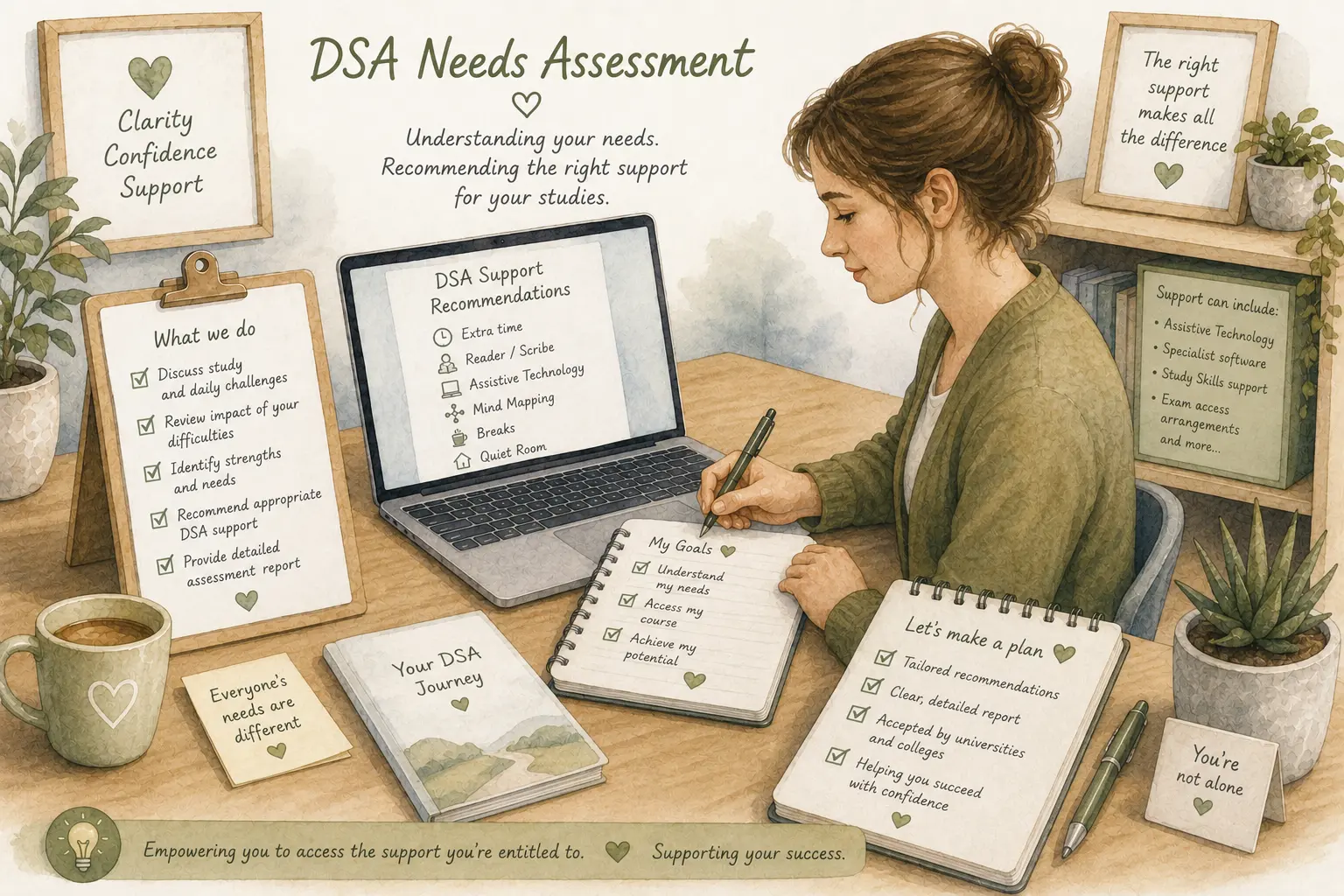
Illustration explaining what happens at a DSA needs assessment meeting
View this illustration larger
  1. 01

    Check your evidence

    Funding bodies and universities set out what evidence they accept. For a specific learning difficulty this is normally a post-16 diagnostic assessment report from an appropriately qualified assessor. Check the requirement before you pay for anything.

  2. 02

    Apply

    Disabled Students' Allowance in the UK is applied for through your funding body. Student Finance England, SAAS, Student Finance Wales or Student Finance NI. It is separate from your university application and is not means tested.

  3. 03

    Needs assessment

    If your application proceeds, you attend a study needs assessment at an assessment centre. That is a different appointment from a diagnostic assessment, and it is where specific equipment and support are recommended.

  4. 04

    Support is put in place

    Recommendations may include assistive technology, specialist study skills support or other help. What is agreed depends on your circumstances and the funding body's decision.

Study demands

Where the workload actually bites, and what helps

Reading volume

Reading lists are long and selective reading is a skill in itself. Text-to-speech, skim-reading strategies and knowing which chapters matter make a large difference.

Note-taking

Lectures move quickly. Recorded lectures, lecture slides in advance, note-taking software or a structured template all help.

Assignment planning

Long deadlines with no interim checkpoints. Working backwards from the deadline into small dated steps is the single most useful habit.

Academic writing

Structure, referencing and proofreading take longer with dyslexia. Study skills tutorials and proofreading strategies are worth using early.

Organisation

Timetables, seminars, group work and part-time jobs. One calendar that everything goes into beats several systems.

Self-advocacy

Being able to explain your profile briefly and practically (what helps, what does not) is more useful than any document.

Free interactive resource

Preparing for University with Dyslexia checklist

Use this over the summer before you start, or in your first few weeks. Tick as you go and print it if you want something to take to student support.

0 of 18 ticked0%

Understanding your evidence

Contacting the university

Funding and DSA

Eligibility, funding and outcomes are decided by the funding body, not by an assessor.

Study systems before you arrive

Looking after yourself

Keep a copy

Your ticks are saved in this browser only. There is no sign-up and no email address needed. Take a copy with you if it helps for a meeting with school, university or work.

The download is a small branded file you can open, save or print on any device. “Email myself a copy” opens your own email app with the text already written, no address is collected, nothing is stored by Defining Dyslexia, and you are never added to any mailing list.

This checklist is also listed in Free resources.

If you have no evidence yet

When a diagnostic assessment is worth considering

Some students reach higher education with long-standing difficulties that were never formally explored. If your university or funding body asks for a post-16 diagnostic assessment and you do not have one, Defining Dyslexia carries out full assessments for students, remotely across the UK or face to face in the Sheffield and Peterborough areas.

A full diagnostic assessment costs £495, including the assessment session and a written report with practical recommendations. Before booking, check what your institution and funding body require, so you know the report will do the job you need it to do.

University and college assessments Book a free 15-minute telephone callChoose a convenient time for a relaxed, no-obligation telephone call. Mark will call you using the number provided when booking.

Knowledge Centre

Further reading before you start

The journey

Dyslexia through life and learning

Needs change as education and work change. These are the points where the demands shift most, and what Defining Dyslexia offers at each one, guidance and free resources as well as assessment.

  1. Primary years

    Roughly ages 5–11

    Reading and spelling are being learned. Some able children compensate well, so difficulty can be hidden behind good comprehension and strong spoken language.

  2. Preparing for secondary

    Years 5–7Transition point

    Organisation, timetables, multiple teachers and heavier reading arrive together. A little planning in Year 6 makes the move considerably calmer.

  3. Secondary and exams

    Years 7–13

    Subject vocabulary, note-taking, coursework and timed exams place different demands on literacy, memory and processing speed.

  4. Preparing for university

    Years 12–13 and mature applicantsTransition pointYou are here

    Support is requested rather than arranged for you. Knowing your own profile and who to contact matters more than it ever did at school.

  5. University and college

    Higher and further education

    Reading volume, independent study and academic writing increase. Evidence of a specific learning difficulty may be needed for study support or a DSA application.

  6. World of work

    Employment and trainingTransition point

    Dyslexia looks different at work: email, reports, meetings, deadlines and reading under pressure. Many adults are identified for the first time here.