They Can Focus on Minecraft for Hours — So Why Not Schoolwork?
"If they can concentrate on Minecraft for three hours, they can concentrate on their homework." It feels logical, but attention does not work like that. Here is why — and how to borrow what games do well.
By Mark, specialist dyslexia assessor
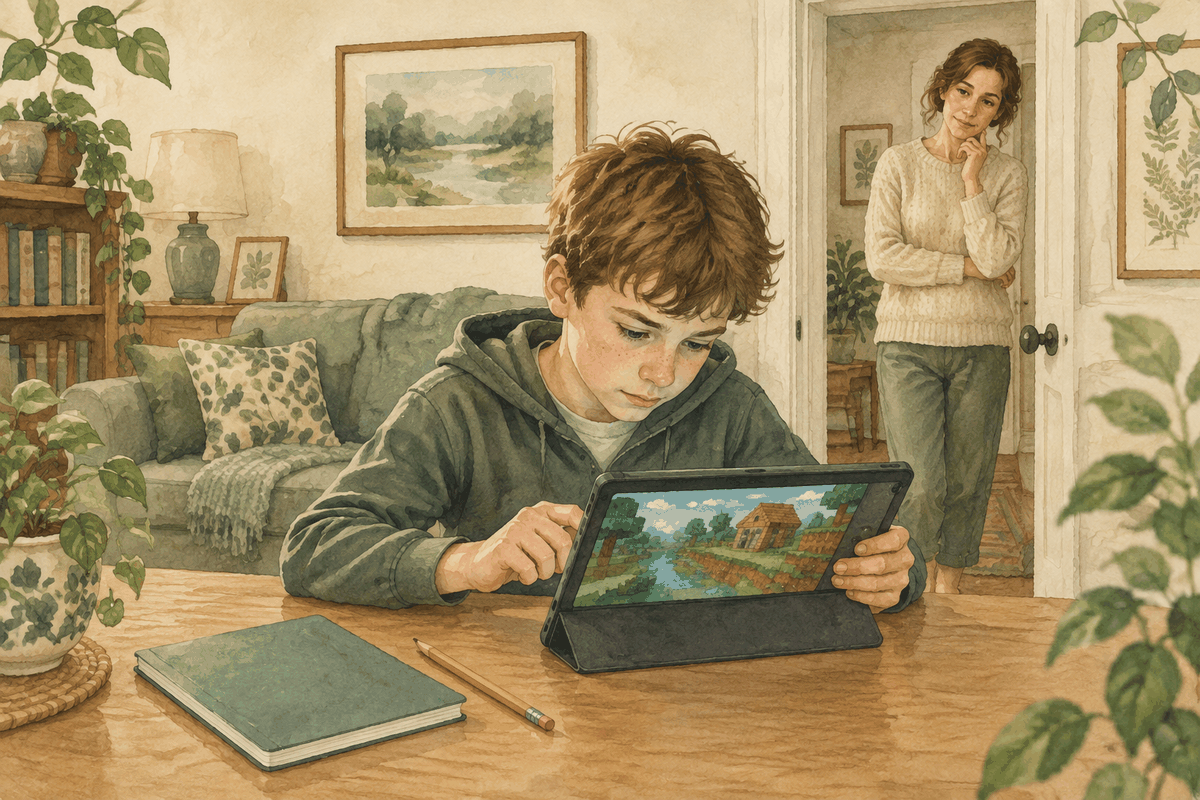
It is one of the most common things parents say: "He can build in Minecraft for hours without looking up, but ten minutes of spelling and he's under the table." It can feel like proof that the child could concentrate on schoolwork if they chose to.
It is an understandable conclusion. It is also usually wrong. Focusing on a game and focusing on difficult schoolwork use attention in very different conditions.
What is interest-based attention?
Attention is strongly driven by interest, novelty, challenge at the right level and urgency. When a task is engaging, attention is pulled along with little effort. When it is dull or hard, attention has to be pushed, and pushing uses up energy. All of us work this way; some children feel the difference much more sharply.
What games do that schoolwork usually does not
- Immediate feedback — every action produces a visible result within seconds.
- Small, clear goals — build this, find that, reach the next level.
- Frequent reward — regular moments of success keep motivation topped up.
- Choice and control — the child decides what to do and how.
- Low cost of mistakes — failure is quick, private and easily undone.
- Little reading or writing — for a child with literacy difficulties, the barrier is simply not there.
A worksheet often reverses every one of these: delayed feedback, vague goals, little choice, visible mistakes and a lot of reading and writing.
Why difficulty changes everything
For a child who finds reading or spelling hard, schoolwork carries extra cognitive load. Every sentence takes effort. That effort is tiring, and the rewards arrive slowly, if at all. Avoiding it is a very human response, and it can look like a focus problem when the real barrier is the task itself. Our article on why reading can leave a child exhausted explains this in more detail.
For a child who finds reading or spelling hard, schoolwork carries extra cognitive load.
Starting is often the hardest part
Many children struggle most with getting going. Task initiation is an executive-function skill: working out where to start, holding the steps in mind and pushing past the initial reluctance. Games remove that barrier with a big, obvious "play" button. Homework rarely has one.
Is this a sign of ADHD?
Intense focus on preferred activities alongside difficulty with less interesting tasks is often described in ADHD, and sometimes called hyperfocus. But this pattern is also extremely common in children without ADHD. It cannot be used to identify ADHD, and it does not rule it out either.
Dyslexia and ADHD frequently co-occur, and each can make the other harder to see — our guide to dyslexia and ADHD explains more. Defining Dyslexia does not diagnose ADHD; where attention is a significant concern, our ADHD and autism assessment pathways page outlines appropriate routes.
How can I use game-like strengths without gimmicks?
The aim is not to turn every task into a game. It is to borrow the conditions that make games easier to engage with.
- Make the first step tiny and obvious. "Write the date" is easier to start than "do your homework".
- Break work into short rounds with a clear end point: five questions, then a pause.
- Make progress visible — tick boxes, a checklist, a simple chart.
- Give feedback quickly. Check the first two answers together rather than marking everything at the end.
- Offer real choices: which task first, pen or laptop, kitchen or bedroom.
- Reduce the reading and writing barrier with read-aloud tools, dictation or talking through answers first.
- Separate screens from start-up. Agree when game time happens, so homework is not competing with it in the moment.
More practical ideas are in our guides to homework strategies that actually help and helping your child at home.
What to say instead of "you can do it when you want to"
Comments that imply laziness tend to stick. Children who hear them often decide they are the problem. Try naming the difference instead: "Minecraft gives you lots of quick wins. Spelling doesn't. Let's make spelling a bit more like that." Our article on dyslexia and self-esteem explores why this matters.
When might it be worth looking further?
It may be worth exploring further if avoidance of schoolwork is persistent, if reading, spelling or writing seem much harder than you would expect, or if attention difficulties are showing up across home and school. Understanding what is driving the difficulty — literacy, attention, both or something else — helps you choose the right support.
Looking at the wider picture: attention often overlaps with memory, processing and confidence. See looking at the whole child.
Frequently asked questions
Why can my child focus on video games but not homework?
Games provide instant feedback, clear goals, choice and frequent reward, with little reading or writing. Difficult schoolwork often provides none of these. Attention is much easier to sustain in the first situation.
Does hyperfocus on games mean my child has ADHD?
Not on its own. Intense focus on preferred activities is described in ADHD but is also very common in children without it. ADHD can only be identified through an appropriate specialist assessment.
Should I use games as a reward for homework?
Agreed routines can help, but constant bargaining can make homework feel like a barrier to what matters. Many families find it easier to set a predictable time for each and to make the homework itself more manageable.
Can dyslexia make homework harder to focus on?
Yes. When reading and writing take extra effort, schoolwork becomes more tiring and less rewarding, which can look like poor focus. Reducing the literacy barrier often improves engagement.
About Defining Dyslexia and the author

About the author
Mark
Specialist dyslexia assessor and founder of Defining Dyslexia
Mark is a qualified teacher and specialist assessor who has worked across mainstream and SEND education, including as a SENCo. He holds an Assessment Practising Certificate and is a member of PATOSS, and he carries out every Defining Dyslexia assessment personally, from the first conversation through to talking the report through with you.
- PATOSS member
- Assessment Practising Certificate
- PGCE
- NASENCo
- CPT3A
- PgDip SpLD
About Defining Dyslexia
Diagnostic dyslexia assessments for children, adults and students
Defining Dyslexia provides full diagnostic SpLD assessments for children, adults and university and college students. Face-to-face assessments are available in Sheffield and South Yorkshire, Peterborough and Cambridgeshire, and Stamford and Rutland, with remote assessments available UK-wide. Every assessment includes time to talk through the findings together, so you leave with a clear understanding of the results rather than a document to decipher alone.
If you have questions, or you are wondering whether an assessment might be the right next step, a free 15-minute telephone call is available with no obligation.