Remote · UK-wide
Online dyslexia assessments across the UK
Full diagnostic dyslexia assessments from home, for adults, university and college students, and children where a remote assessment is appropriate. Wherever you are in the UK, the assessment is carried out personally by Mark, a PATOSS-registered specialist assessor holding a current Assessment Practising Certificate.
The session runs live over a secure video platform, using standardised tasks suitable for remote administration, at an unhurried pace with breaks built in. What follows is a full diagnostic report, the same document produced after a face-to-face assessment.
- £495 full diagnostic assessment, report included
- Available anywhere in the UK
- Adults, students and children where suitable
- Assessed by your assessor personally
Transparent pricing
£495
Full diagnostic dyslexia assessment
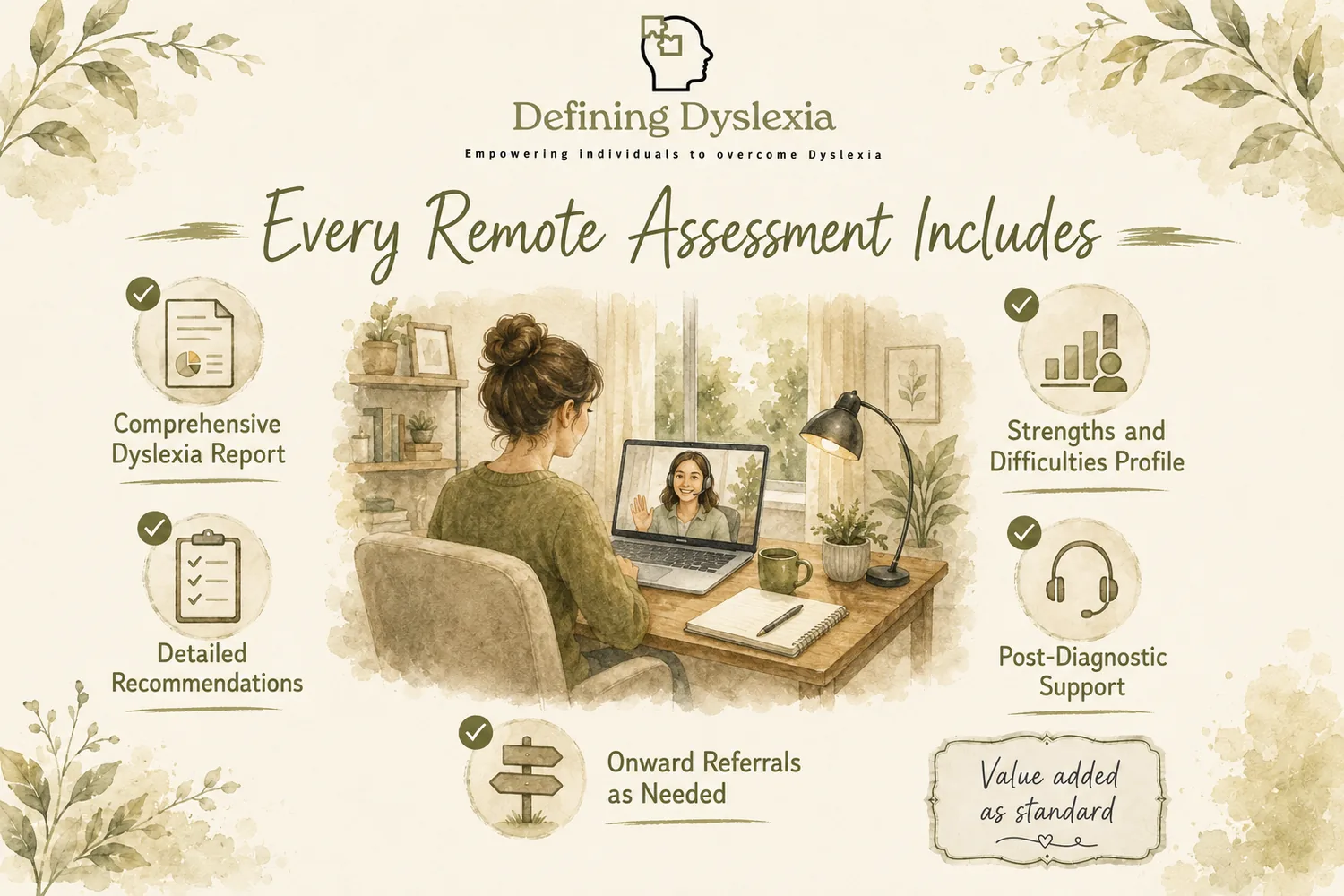
- The full assessment session
- The comprehensive written diagnostic report
- Practical recommendations for school, study or work
- A conversation to talk the findings through
- No venue fee with a remote assessment
Where an adult assessment includes screening for co-occurring difficulties such as ADHD or dyspraxia, a small additional fee applies and is agreed with you first.
Full pricing and payment options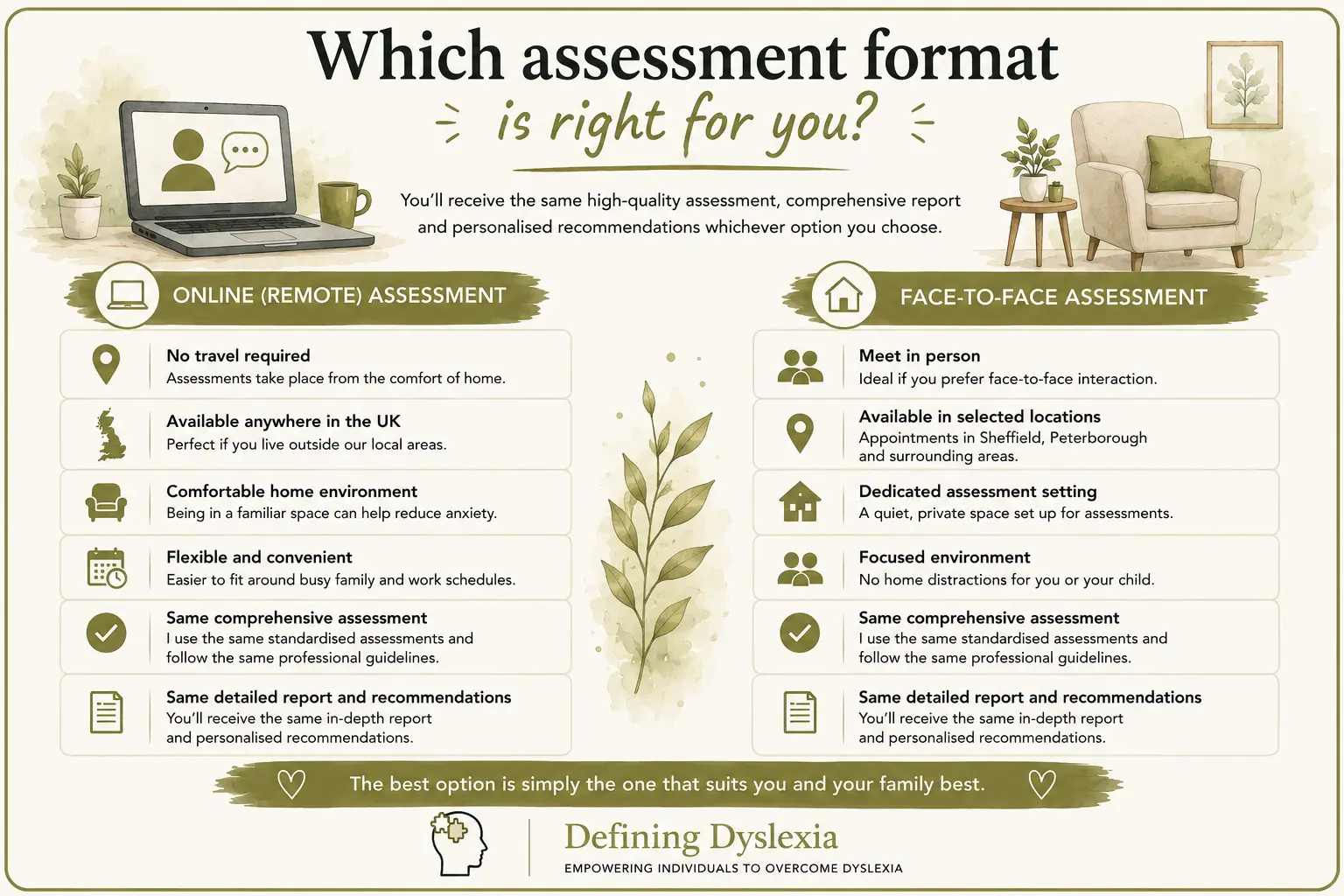
Before the assessment
We build the picture together
A remote assessment is not simply a series of tests on a screen. It brings together what you notice day to day, what school, college or work has observed, and what the assessment itself shows. A little background makes the report far more useful, but you do not need to have everything before getting in touch. We can work with the information available and help you identify anything else that may be useful.
Before you go further
An online dyslexia test is not the same as a diagnostic assessment
People often search for an "online dyslexia test" when what they actually need is a diagnostic assessment, and sometimes the other way round. Both have their place, and they are very different things.
Free online indicators
A short set of questions about everyday reading, writing, memory and organisation. They take a few minutes, cost nothing, and give you a structured picture of whether the pattern you are noticing is one commonly associated with dyslexia. They do not identify dyslexia and they are not a screening or diagnostic tool. Think of them as a way of deciding whether it is worth taking the next step.
A full diagnostic assessment
A detailed one-to-one evaluation lasting around two to three hours, using standardised measures across reading, spelling, writing, phonological processing, memory and processing speed, alongside background history. It concludes with a written diagnostic report and practical recommendations. This is the £495 service on this page, and it can be delivered remotely where that is appropriate.
If you are not sure which you need, the free indicators are the sensible place to start, and we are happy to talk it through before you commit to anything.
Included as standard
Every remote assessment includes
Why choose remote
What a remote assessment makes possible
Remote assessment is not a compromise version of a face-to-face assessment, and it is not automatically the better option either. It removes some genuine practical barriers, and whether those barriers are the ones standing in your way is worth thinking about.
No travelling
No long drive, no unfamiliar venue, no full day given over to the appointment.
A specialist wherever you live
Access to a PATOSS-registered assessor regardless of what is available locally.
A familiar environment
Many adults and children settle more quickly somewhere they already know.
Easier scheduling
Simpler to fit around work, lectures, placements, childcare and school hours.
Breaks and split sessions
Pace it around the person: breaks whenever needed, or two shorter sessions.
Practical for adults and students
Particularly workable for adults in employment and students studying away from home.
The honest answer
Is an online dyslexia assessment valid?
Diagnostic dyslexia assessment can be undertaken remotely where it is professionally appropriate and where the tasks used are suitable for remote administration. That is the important qualification: it is not that everything can be done online, but that a properly conducted remote assessment is a full diagnostic assessment rather than a lighter version of one.
Defining Dyslexia works to the standards set by SASC, the body that oversees SpLD assessment quality in the UK, and holds a current Assessment Practising Certificate. The report produced from a remote assessment is written to the same standards as one produced in person and states clearly how the assessment was conducted.
What no assessor can honestly promise is how a third party will respond. Schools, colleges, universities, exam boards, employers and local authorities each apply their own criteria when deciding on support, exam access arrangements, DSA, workplace adjustments or EHCP provision. A diagnostic report provides robust evidence for those conversations; it does not guarantee a particular outcome, and any assessor who tells you otherwise is overstating what a report can do.
Equally, not every person or situation suits remote delivery. Suitability is considered individually at enquiry, and where a face-to-face assessment would give a more reliable picture, that is what will be recommended.
Professional standards behind the report
- Assessed and reported to SASC standards
- Current Assessment Practising Certificate (APC)
- PATOSS-registered specialist assessor
- Qualified teacher and former SENCo
- Enhanced DBS certificate and safeguarding policy
- Standardised measures suitable for remote administration
Step by step
What actually happens in a remote assessment
- 01
Enquiry and initial discussion
You get in touch or book a free telephone call. We talk through the circumstances, what has prompted the enquiry, and whether a remote assessment is appropriate in this case or whether face-to-face would give a better picture.
- 02
Background information
Relevant background is gathered beforehand, developmental and educational history, current difficulties, and where useful, information from school, tutors or an employer. This shapes the assessment before the session begins.
- 03
Prepare your space
You are sent clear guidance about the equipment, connection, materials and environment needed, plus joining instructions. A short technical check confirms everything works so nothing is a surprise on the day.
- 04
The assessment session
You meet your assessor on a secure video platform and work through standardised tasks covering reading, spelling, writing, phonological processing, memory and processing speed, with each activity guided live.
- 05
Breaks and pacing
Breaks are built in and taken whenever they are needed. Where a shorter format suits better, the assessment is split across two sessions rather than pushed through in one.
- 06
Report and next steps
A comprehensive written report follows, with the findings and practical recommendations, and a conversation to talk it all through and answer questions.
Practicalities
What equipment do I need?
Nothing specialist, and nothing you need to buy. Everything below is confirmed with you in advance, and a short technical check before the day makes sure it all works. Any additional materials needed for particular tasks are explained beforehand. Everything else is provided by the assessor.
A laptop or desktop computer
A full-size screen and keyboard work best. Tablets and phones are not suitable for the screen-shared tasks.
Camera and microphone
Your assessor needs to see and hear you clearly throughout, observation is part of the assessment, not an optional extra.
A reliable internet connection
A stable connection matters more than a fast one. A wired connection or a spot close to the router is ideal.
A quiet, private room
Timed and spoken tasks need a room where you or your child will not be interrupted, with a desk or table and a comfortable chair.
Paper and a pen or pencil
Some tasks are handwritten. You will be told in advance exactly what to have ready on the desk.
Glasses or hearing aids
If they are normally worn for reading or listening, they should be worn for the assessment.
Who it is for
Adults, students and children
Adults
Remote assessment for adults
Most adults who contact Defining Dyslexia have been carrying the question for years. Some are struggling with reading, writing or organisation at work; some are returning to study or moving into professional qualifications; some simply want to understand a pattern that has followed them since school.
Remote assessment suits adult life well: no travel, no full day away from work, and the session takes place somewhere familiar. The report sets out the profile clearly and makes practical recommendations you can take to an employer, a training provider or a university.
University & college
Remote assessment for students
Students are often the group for whom remote assessment is most practical. You may be studying a long way from home, without a car, working around lectures, placements and deadlines, or trying to get evidence in place before an assessment period.
Many students seek an assessment as part of accessing support at university, including applying for Disabled Students' Allowance. Universities and funding bodies each set their own evidence requirements, so it is worth checking what yours asks for, the assessment provides the diagnostic evidence rather than guaranteeing a particular outcome.
Children & young people
Remote assessment for children: when it fits, and when it does not
Some children work very well remotely. Being at home can be calmer than an unfamiliar room, and for families a long way from a specialist assessor it may be the only realistic route to an assessment.
It is not right for every child. Age, how comfortably a child can engage with a screen-based session for a sustained period, the quiet of the home environment, the technology available and what the assessment needs to cover all matter. Where a face-to-face assessment would give a more reliable picture, Mark will say so at enquiry rather than after you have paid. A parent or carer stays in the home throughout a remote session.
Deciding
Remote or face-to-face, which should I choose?
Neither is the better assessment. They are two legitimate ways of delivering the same diagnostic process, and the right one depends on the person being assessed and the practicalities around them.
| Consideration | Remote | Face-to-face |
|---|---|---|
| Where you are | Anywhere in the UK, from home, a study bedroom or a private room at work. | South Yorkshire, Cambridgeshire, Stamford, Rutland and the surrounding areas. |
| Travel and time | No travel, no venue to find, easier to fit around work, study or childcare. | Travel to an agreed venue, home or school, with time set aside around it. |
| Environment | Familiar surroundings, which settles many people, but you provide the quiet room. | A controlled, distraction-free space arranged for the assessment. |
| Technology | Needs a computer, camera, microphone and a reliable connection. | Nothing needed from you; all materials are brought to the session. |
| Suitability | Well suited to most adults and students, and to many children, considered case by case. | Often the better option for younger children or where engagement with a screen is harder. |
| The assessment itself | Same standards, same diagnostic process, same written report. | Same standards, same diagnostic process, same written report. |
About your assessor
You will know exactly who is assessing you
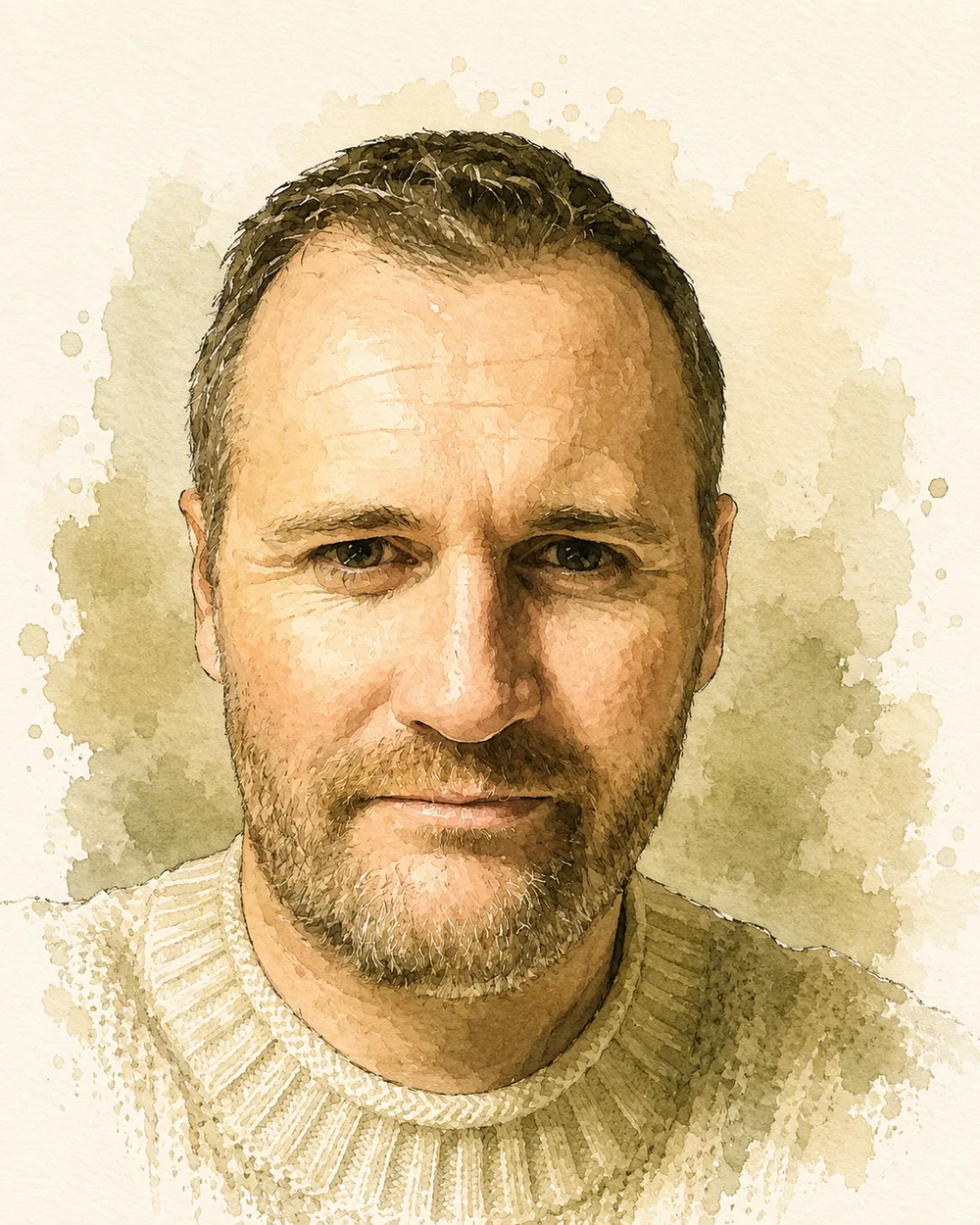
This matters more with a remote assessment, because you may never meet in person. Every Defining Dyslexia assessment is carried out by Mark personally, a PATOSS-registered specialist assessor with fifteen years of experience working with children, young people and adults, holding a current Assessment Practising Certificate and working to SASC standards.
He is a qualified teacher and former SENCo, which shapes how the reports are written, for the people who have to use them. You speak to him at enquiry, he carries out the assessment, and he writes the report. You are not allocated to an unknown assessor by a national company.
More about MarkNot ready to book
Not sure whether an assessment is the right next step?
Start with a free indicator. They are structured, take a few minutes, and give you something clearer to think about, but they are indicators, not diagnostic assessments, and they cannot identify dyslexia.
Free Child Dyslexia Indicator
For parents and carers noticing a pattern at home or hearing concerns from school.
Start the child indicatorFree Adult Dyslexia Indicator
For adults at work, in study or returning to study who have long wondered.
Start the adult indicatorFree resources
Checklists, the pathway finder and preparation guidance, all free to use.
Browse free resourcesLocal information
Looking for local SEND support?
We assess remotely across the UK, so rather than list every council here, use GOV.UK to find your authority and its Local Offer: the free, public summary of SEND provision it must publish for children and young people up to 25.
Defining Dyslexia is an independent specialist assessment service. We are not part of, commissioned by or endorsed by any local authority.
Common questions
Online and remote assessment: frequently asked questions
01Can dyslexia be diagnosed online?
A full diagnostic dyslexia assessment can be carried out remotely where it is professionally appropriate to do so, using standardised tasks that are suitable for remote administration. It is the same diagnostic process as a face-to-face assessment, delivered over secure video. Suitability is considered individually at enquiry stage, and where a face-to-face assessment would give a more reliable picture, Mark will say so.
02Is an online dyslexia assessment valid?
Yes, when it is conducted by a suitably qualified assessor working to SASC standards with appropriate tools. Your assessor holds a current Assessment Practising Certificate (APC) and is registered with PATOSS. The report produced is a full diagnostic report and is not labelled or treated as a lesser assessment. Individual schools, colleges, universities, exam boards, employers and local authorities each apply their own criteria when deciding what support or adjustments to put in place, so the report provides the evidence rather than guaranteeing a particular outcome.
03Is a remote assessment the same as an online dyslexia test or screening?
No. A free online dyslexia test, checklist or screener gives an indication of whether traits associated with dyslexia are present. It cannot identify dyslexia. A diagnostic assessment is a detailed one-to-one evaluation using standardised measures, resulting in a written diagnostic report. Our free indicators are a starting point; the £495 assessment is the diagnostic route.
04How does an online dyslexia assessment work?
After an initial conversation, background information is gathered in advance and you are sent joining instructions and a short checklist. The assessment itself takes place live over secure video, with Mark guiding each task in real time, sharing materials on screen and observing throughout. A written report follows, along with a conversation to talk the findings through.
05How long does an online dyslexia assessment take?
Most assessments take around two to three hours, with breaks. Where a shorter format would suit better (for younger children, or for anyone who would find a long session tiring) the assessment can be split across two shorter sessions.
06What equipment do I need?
A laptop or desktop computer with a working camera and microphone, a reliable internet connection, and a quiet, private room where you or your child will not be interrupted. Paper and a pen or pencil are needed for written tasks, and glasses or hearing aids should be worn if you normally wear them. Everything else is provided by the assessor on the day, and a short technical check is carried out beforehand.
07Can children have an online dyslexia assessment?
Some children can be assessed remotely and some are better assessed in person. It depends on age, how comfortably the child can engage with a screen-based session, the home environment, the technology available and what the assessment needs to cover. Where remote assessment is used with a child, a parent or carer stays in the home throughout. Suitability is discussed honestly at enquiry stage rather than assumed.
08Can adults be assessed remotely?
Yes. Remote assessment works well for most adults, and it is the route many adults choose because it avoids travel and time away from work. The session runs in exactly the same way as a face-to-face assessment.
09Can university and college students have an online assessment?
Yes. Remote assessment is often the most practical option for students studying away from home or working around timetables and deadlines. Universities and funding bodies set their own evidence requirements, so it is worth checking what your institution or a DSA application asks for. Mark can talk this through before you book.
10How much does an online dyslexia assessment cost?
£495 for a full diagnostic assessment including the comprehensive written report and practical recommendations. There are no venue fees with a remote assessment. Where an adult assessment includes screening for co-occurring difficulties such as ADHD or dyspraxia, a small additional fee applies and is agreed with you before anything is confirmed.
11What happens if dyslexia is not identified?
You still receive the full written report. An assessment that does not identify dyslexia is not a wasted assessment: it sets out the profile of strengths and difficulties found, considers other explanations for what you have been seeing, and gives recommendations based on that profile. Many people find that answer as useful as a diagnosis.
12Can I have breaks during the assessment?
Yes. Breaks are built in as standard and more can be taken whenever they are needed. The session is paced around the person being assessed, not the other way round.
13Do I need to travel anywhere?
No. A remote assessment takes place wherever you are, as long as you have a suitable quiet room and a reliable connection. Face-to-face assessments are available across South Yorkshire, Cambridgeshire, Stamford and Rutland if you would prefer to be assessed in person.
14What happens after the assessment?
You receive a full diagnostic report setting out what was assessed, the results, the conclusion and practical recommendations for education, study or work. Your assessor then talks the findings through with you so you understand what they mean and what sensible next steps look like.
Read further
Guidance from the Knowledge Centre
Can a dyslexia assessment be done remotely?
How remote assessment works in practice, and where in-person may suit better.
What equipment do I need for a remote assessment?
The simple setup: device, camera, microphone, internet, room and materials.
Dyslexia test or dyslexia assessment: what's the difference?
Why an online test is not the same thing as a diagnostic assessment.
Finding an assessment near you: online and in-person options
Weighing up local availability, waiting times and remote access.
How to prepare for a dyslexia assessment
What to gather, what to tell your child, and how to settle the day.
What a dyslexia assessment report actually looks like
The document you receive afterwards, section by section.
What PATOSS registration means
How to check the credentials of any assessor, remote or in person.
Coverage
UK-wide remotely, face-to-face in these areas
Remote assessment means Defining Dyslexia can work with suitable clients anywhere in the United Kingdom. There is no local list to check. If you would rather be assessed in person, these are the areas covered face-to-face.