

Will My Child's School Accept a Private Dyslexia Assessment?
A private diagnostic report is professional evidence, but ‘accepting’ it can mean several things. Here is how to involve school and use the findings constructively.
Read the articleKnowledge Centre topic

Working with schools, colleges and universities: screening, exam access arrangements, SENCos and classroom support.
Articles

A private diagnostic report is professional evidence, but ‘accepting’ it can mean several things. Here is how to involve school and use the findings constructively.
Read the article

A child may cope through primary school, then struggle as secondary reading, writing and organisation demands rise. The difficulty is not new; the context has changed.
Read the article
Phonics and phonological skills matter, but accurate decoding or one reassuring screening measure cannot describe a learner’s complete literacy profile.
Read the articleA nine-part study-skills series for dyslexic learners, parents and teachers: from understanding the question to checking work and managing exam time.
Read the articleWhy some dyslexic learners can explain ideas aloud but struggle to show them in writing, and practical ways to bridge the gap between knowing and showing.
Read the articleWhat describe, explain, compare, analyse and evaluate are really asking for, with a simple command-word routine and reference table for dyslexic learners.
Read the articleGive every paragraph a job, keep the question visible and use a simple skeleton plan so longer answers feel manageable for dyslexic learners.
Read the articleWhy relevance, explanation and structure usually matter more than length, and how dyslexic learners can match their answer to what the question needs.
Read the articlePractical ways to get moving when a blank page leads to a blank mind: three words, a tiny plan, verbal rehearsal and starting with the easiest point.
Read the articleA step-by-step checking routine — question, content, sense, missing words, punctuation, spelling — so checking is useful rather than overwhelming.
Read the articlePractical timing strategies for dyslexic learners: using marks to guide time, moving on when stuck, proportionate checking and making the most of the final minutes.
Read the articleThree simple questions — command word, instruction, key term — that help dyslexic learners unpack an exam or classroom question before they start writing.
Read the articleWhy a short, two-minute plan can take some of the juggling out of writing, with a simple four-step method dyslexic learners can use in class and exams.
Read the article
A complex or incomplete history does not necessarily make a dyslexia assessment impossible. It makes careful evidence gathering, professional judgement and multidisciplinary working particularly important.
Read the article
Mock exams can show where the real barriers appear under timed conditions. Here is why a dyslexia diagnosis does not automatically mean extra time, and how understanding a young person's learning profile helps more.
Read the article
If your child has been assessed with dyslexia, you may have heard the phrase exam access arrangements. It can sound bureaucratic, and many parents are unsure what it actually means in…
Read the article
Secondary school brings a step change in demands. There are more subjects, more teachers, more reading, and more writing under pressure. For a young person with dyslexia, that step…
Read the article
Dyslexia at primary school is often easy to miss. The child in question is usually bright, curious and full of ideas. Reading and writing simply do not click in the way they do for…
Read the article
If you have raised concerns about your child's reading, writing, or spelling and felt like you were talking to a wall, you are not alone. Many parents describe the same experience. A…
Read the article
If you've spent any time navigating the world of SEND support, you may have encountered a deeply frustrating experience, and being told by your local authority that dyslexia isn't…
Read the article
If you've raised concerns about your child's learning and been told by the school that they can't diagnose dyslexia, you're not alone. It's one of the most common things parents hear,…
Read the article

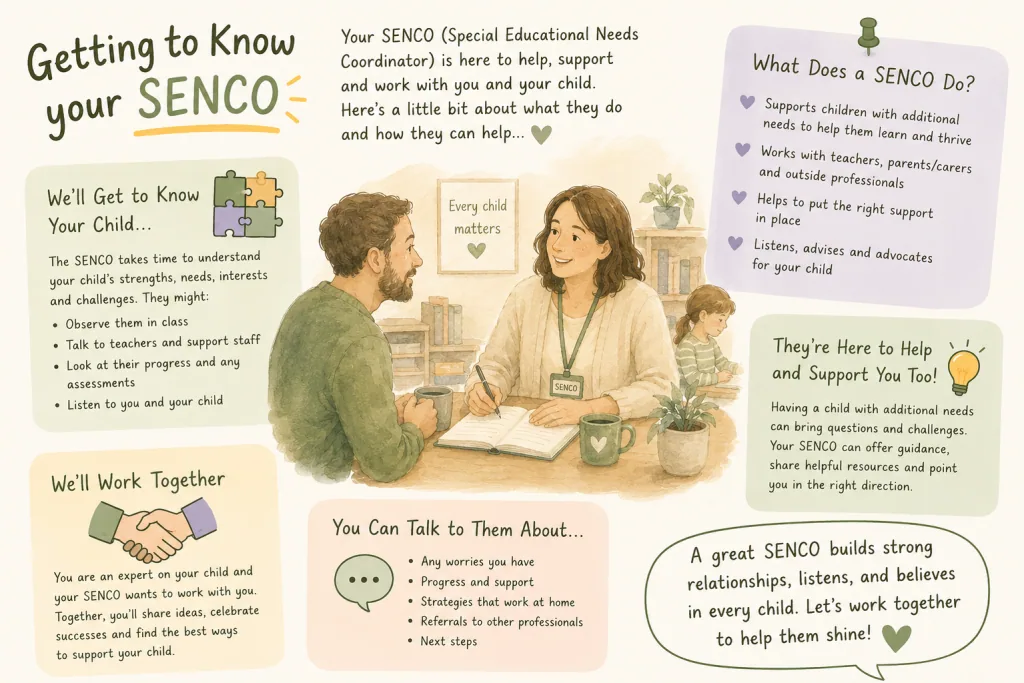
If you have concerns about your child's learning, one of the most important steps you can take is building a good relationship with your school's SENCo. Their Special Educational Needs…
Read the article
Miss Calloway had been teaching for three years, which was long enough to feel competent and short enough to still feel uncertain about feeling competent.
Read the article
Laura knew before anyone told her. That was the thing she would say afterwards, when there was an afterwards to speak of.
Read the articleOther topics